


HPU's General Contractors Association of Hawaii Master of Science in Construction Management is the first and only construction management program in Hawai'i, offered online with optional hybrid course selections.
Tyler Ruso decided early on that the tech industry was not for him. He worked in various project management roles but realized that he needed to follow his heart and dive into something hands-on. Construction management felt right, and after nine months of working for a firm on Kauai, he has enjoyed the switch and has not looked back.
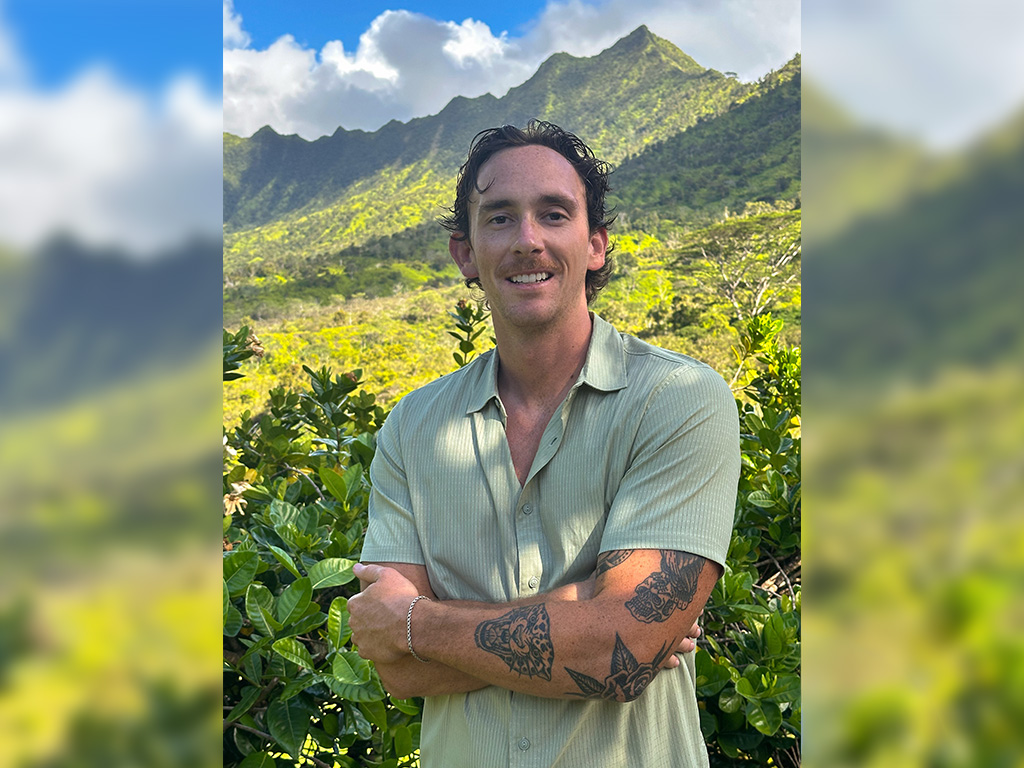
Tyler Ruso.
It was soon into his employment when Ruso’s supervisor recommended that he look into HPU's General Contractors Association of Hawaii Master of Science in Construction Management (MSCM), Hawaiʻi’s only construction management program. "It felt like a great opportunity to build a strong educational foundation alongside my field experience," Ruso shared. "Being newer to the field, I'm eager to acquire both knowledge and experience, and this accelerated program was exactly what I was looking for when comparing it to other degree options. I like that the HPU program is locally rooted, which creates great networking opportunities across the islands."
For someone working full time on Kauai, HPU’s format matters a great deal. Delivered online with optional hybrid course sections, the program features accelerated eight-week semesters and can be completed in as few as 12 months. Rather than following a traditional engineering track, the curriculum is designed specifically for construction and project management professionals, with learning outcomes aligned to the accreditation requirements of the American Council for Construction Education.
Coursework covers construction project planning, scheduling, document interpretation, risk management, resource allocation, procurement, and financial controls, culminating in a supervised internship and comprehensive capstone project.
The classroom has not felt separate from the job site for Ruso. It has felt like a direct extension of it. "The program has been incredibly valuable, especially in helping me connect what I'm learning in class to what I'm seeing every day on the job," he says. "Courses around construction law, procurement and contracts, risk management, and project management concepts and skills have already been directly applicable to the projects I'm working on."
That alignment between study and practice is part of what drew Ruso to the program in the first place. His undergraduate degree is in economics, a background that sharpened his thinking around financial controls and contracts but did not satisfy the credentialing requirements that construction management career paths typically demand.
Project Engineer roles, a natural next step for someone in his position, generally require a degree in an engineering discipline or construction management. The MSCM program bridges that gap without pulling him away from the work he is already doing.
"This program allows me to build the technical foundation necessary and enhance my resume," he says. "Long term, I plan to stay in the civil construction space and eventually move into a Project Manager role here in Hawaiʻi."
The MSCM program is not the only place at HPU where construction management is shaping students' thinking. In Fall 2025, a new student organization called the Construction Management and Analytics Society, or CMAS, was founded to bring together students from across programs around the intersection of construction, data, and decision-making.
Penny Kabua, a Master of Science in Business Analytics (MSBA) student graduating this spring, is one of CMAS's founders. The club grew out of two separate ideas that turned out to be the same conversation. Kabua had been planning to launch a business analytics club when MSCM Program Director Charles Chen, Ph.D., expressed interest in starting a construction management club. As more students got involved, the overlap became hard to ignore.
"We realized this was a great chance to connect business analytics with construction management and create a club that could serve both fields," Kabua says. "Many decisions in construction involve data, planning, risk, financial analysis, and technology, so it felt natural to bring the two areas together."
That connection has a concrete foothold in the curriculum. Methods in Project Management, a course taught by Chen and required in both the MSCM and MSBA programs, covers organization structure, project scheduling, cost and risk management, resource allocation, and agile methods. It is a working example of how the two programs share intellectual ground, and how students in different disciplines are preparing for roles that increasingly demand fluency in both.
CMAS is open to all HPU students, with Chen serving as faculty advisor. The club's first event on March 23 featured Erik Enecker, CEO of Ecometrix and an HPU alumnus, whose work sits at the intersection of sustainability, construction materials, and data analytics. Looking ahead, Kabua envisions the club developing programming around both fields, including a potential internship pipeline for business analytics students.
"Finding a business analyst internship was quite the challenge," she says. "I was turned down multiple times and the spring semester's registration deadline for the internship course was approaching. That's one reason I want CMAS to explore creating an internship program specifically for business analytics students, either with a department on campus or with companies that want to train and eventually hire HPU MS business analytics students."
Kabua is currently completing an internship as a business analyst through the State of Hawaiʻi Hele Imua Program with MedQuest and plans to pursue a data and analytics role after graduation, with staying in Hawaiʻi as her priority.
For Chen, the growth of both the MSCM program and the student community forming around it reflects something larger than coursework. The qualities construction management demands are not simply technical.
"Graduate education is different from undergraduate study," Chen says. "At the graduate level, students are expected to be proactive and self-sufficient. Most of our MSCM students are working professionals, and the program is designed to prepare them for leadership in practice. This means taking initiative, seeking out resources when finance or accounting topics arise or dedicating extra time to master construction drawings if they are unfamiliar."
The program draws students from diverse undergraduate backgrounds, and Chen frames that variety as part of the point. What students studied before matters less than the commitment they bring to what comes next.
"Without cultivating accountability, endurance, and a resilient mindset," he says, "how could construction management graduates be expected to build strong buildings and successful projects in the field?"
For Ruso, that standard is not abstract. It is the work he shows up to every day on Kauaʻi, and the degree he is earning to do it better.
To apply and learn more about HPU's General Contractors Association of Hawaii Master of Science in Construction Management program, click here.