

DHS Published Changes
Current Status: Final rule published, not yet in effect
DHS has published the final rule in the Federal Register. The rule is scheduled to take effect on September 15, 2026. Continue following current OISS guidance.
What is Duration of Status (D/S)?
D/S means your entry to the U.S. is tied to maintaining your status, not one fixed date.
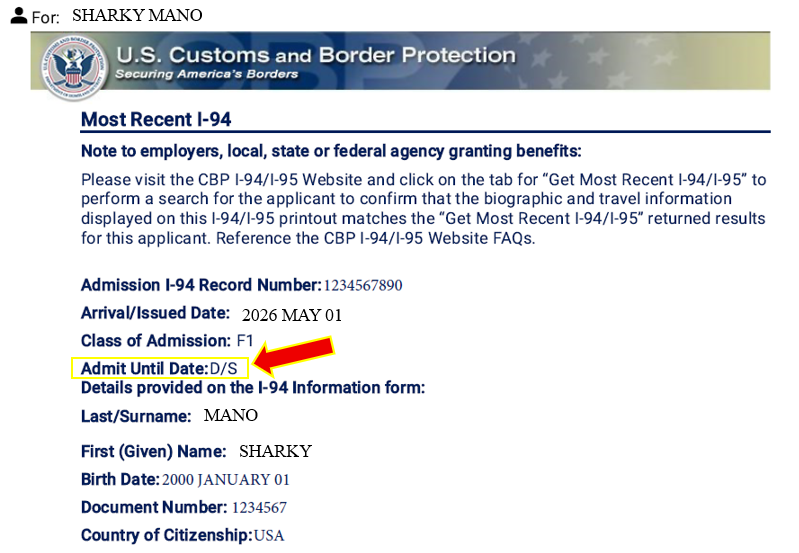
When you enter the U.S. as an F-1 or J-1 student, your Form I-94 should list your Admit Until Date as D/S which stands for Duration of Status.
Under this current policy, you may remain in the U.S. as long as you:
- maintain full-time enrollment
- make progress towards you academic program
- work only with proper authorization
This current policy gives students flexibility to complete their academic programs.
Example of current I-94
PUBLISHED CHANGES TO DURATION OF STATUS
DHS has finalized changes to Duration of Status, but the rule is not yet in effect.
DHS published the final rule on July 17, 2026. The rule is scheduled to take effect on September 15, 2026, unless DHS publishes a notice changing the effective date or terminating the rule after congressional review.
Until then, F-1 and J-1 students should continue following current OISS guidance. OISS is reviewing the final rule and will provide updated guidance for students, staff, and faculty as more information become available.
If the rule takes effect, it will:
- Replace Duration of Status (D/S) with a specific Admit Until Date (AUD) on the Form I-94 for F-1 and J-1 students.
- Admission to the U.S. will generally be limited to the program end date on the Form I-20 or DS-2019 (up to a maximum of 4 years).
- Students who need more time to complete their studies will need to apply to USCIS for an Extension of Stay or travel outside the U.S. to request readmission at a U.S. Port of Entry.
- The standard F-1 grace period will be reduced from 60 days to 30 days.
- New restrictions for undergraduate and graduate students will apply to school transfers and changes to academic programs or educational objectives.
- F-1 students generally cannot begin another F-1 program at the same or lower educational level after completing a program.
PUBLISHED CHANGES TO DURATION OF STATUS
The final rule has been published, but the rule is not yet in effect.
Continue following current immigration requirements and OISS guidance. The final rule is scheduled to take effect on September 15, 2026, unless DHS publishes a notice changing the effective date or terminating the rule after congressional review.
Transition period
Students in the U.S. under D/S on September 15, 2026 will have a transition period.
Under the final rule, F-1 and J-1 students who are in the U.S. and properly maintaining D/S status on September 15, 2026 will be allowed to remain in the U.S. based on their current I-20, DS-2019, or Employment Authorization Document timeline, subject to limits in the final rule.
OISS is reviewing these transition exceptions, including how they apply to current students, students on practical training or academic training, travel, and requests for additional time. Continue following current ISS guidance.
PROCESSES THAT MAY BE AFFECTED
Some immigration-related processes will change if the rule takes effect.
Students may need to pay closer attention to timelines connected to their academic program, immigration documents, travel, employment authorization, and extension of stay requirements.
- Program extensions
- I-20 or DS-2019 end date planning
- Extension of Stay applications with USCIS
- School transfers
- Change of education level or academic program
- Beginning a new program at the same or lower degree level
- Practical training, STEM OPT, or academic training timelines
- Travel and reentry after the rule takes effect
- Grace period planning after program completion
What Students should do now
Use this time to review your documents and watch for OISS guidance.
- Check your I-94 and confirm whether your admission period shows D/S.
- Review the program end date on your I-20 or DS-2019.
- Continue making normal progress in your academic program.
- Plan early and discuss with your department if you may need more time to complete your program.
- Do not submit new applications or requests based only on the final rule.
- Monitor your student email for ISS updates as we review the final rule and any DHS implementation guidance.
- Questions/Concerns? Contact us at iss@hpu.edu.
Student planning
How the final rule may affect students when it takes effect
| Immigration Process | Current Rule | Final Rule Once Effective |
| Length of Stay | Your Form I-94 shows D/S. This means you may stay in the U.S. as long as you maintain your student status and your Form I-20 or DS-2019 is valid. | Your Form I-94 would show a specific Admit Until Date (AUD) instead of D/S. Your stay in the U.S. would generally be limited to the program end date listed on your Form I-20 or DS-2019, up to a maximum of four years. |
| Travel and Re-Entry | F-1 and J-1 students are generally readmitted for D/S if they have valid travel documents and maintain their status. | After the rule takes effect, students returning to the U.S. will receive a specific Admit Until Date (AUD) on their new Form I-94, even if they previously had D/S. Review ISS travel guidance before international travel. |
| Need More Time to Graduate? | OISS can extend your I-20 or DS-2019 if you have an academic or medical reason for needing additional time. No USCIS application or filing fee is required. | Students will need to file an Extension of Stay (EOS) application with USCIS or travel and request readmission to the U.S. |
| Program Extension | You must request an I-20 or DS-2019 extension before your program end date. | You will need both an updated I-20 or DS-2019 and a USCIS Extension of Stay application before your period of stay expires or travel and request readmission to the U.S. |
| Grace Period After Completing Your Program (F-1) | F-1 students have a 60-day grace period after completing their program or authorized post-completion practical training. | The standard F-1 grace period would be reduced to 30 days. |
| Changing Degree Levels | Students may generally begin a higher degree program by obtaining a new I-20 or DS-2019 and following OISS procedures. | Students will still be able to begin a higher educational level, but will need to file an Extension of Stay (EOS) application with USCIS or travel and request readmission to the U.S. |
| Starting Another Program at the Same or Lower Degree Level | Generally permitted if all immigration requirements are met. | After the rule takes effect, F-1 students who complete a program will generally not be allowed to begin another academic program at the same or lower educational level. |
| Transferring Schools | Eligible students may transfer their SEVIS record through OISS without filing an application with USCIS. | Undergraduate students will not be allowed to transfer during the first academic year, and graduate students will not be allowed to transfer at any point during a program. |
| Changing Majors or Academic Objectives | Generally allowed if the change is appropriate and your immigration record is updated when required. | Undergraduate students will not be allowed change academic major or academic program during the first academic year, and graduate students will not be allowed to change their major or academic program at any point during a program. |
| Dependents (F-2/J-2) | Dependents remain in status as long as the primary F-1 or J-1 student maintains status. | Dependents’ period of admission to the U.S. will be tied to the primary F-1 or J-1 student’s fixed admission period and any approved extensions. |