

Master of Science in Business Analytics and Artificial Intelligence
LEAD through dta driven decison making
Turn data into actionable business insights and develop the leadership skills needed to drive organizational success. Hawai‘i Pacific University's Master of Science in Business Analytics and Artificial Intelligence (MSBAAI) combines analytics, business strategy, and industry-recognized tools to prepare working professionals, career changers, military-affiliated students, and recent graduates to lead in today's data-driven economy.
Earn industry-recognized credentials from Tableau, Altair RapidMiner, and IBM through coursework designed to build practical analytics skills and demonstrate career-ready competencies.
At A Glance

Class Settings
-
Online
- Starting Spring 2027, Hybrid

START DATES
- Fall Entry: August
- Spring Entry: January

COURSE INFORMATION
- 30 Credits
- Complete in 21 Months Full Time

TUITION
All costs can be found at hpu.edu/costs.

ADMISSION REQUIREMENTS
-
Online application with $55 fee (waived when attending an event or 1:1 consultation)
- Official transcript/s (bachelor’s degree or higher)
- Resume
OPTIONAL
- Letters of recommendation
- Personal Statement/Essay
Request Info
Meet the MSBAAI Program Chair

Ghazwan Hassna, Ph.D.
Associate Professor of Information Systems
Program Chair, Master of Science in Business Analytics and Artificial Intelligence
Dr. Ghazwan Hassna brings extensive experience in business analytics, information systems, digital transformation, and technology strategy. His academic and professional work has focused on helping organizations use data, technology, and innovation to improve decision-making and organizational performance.
Before joining HPU, Dr. Hassna worked on technology-enabled transformation initiatives with government agencies, international organizations, and development programs across multiple regions. His expertise helps ensure students develop practical skills aligned with current workforce needs and emerging trends in analytics.
"Organizations today are generating more data than ever before, but data alone does not create value. Success comes from the ability to analyze information, identify meaningful insights, and make informed decisions. Our goal is to prepare students with the analytical, technical, and business skills needed to solve real-world challenges and lead in a data-driven world."
Complete in 21 months as a full-time student
Access to Coursera Career Academy
designed for working professionals
Learn by Doing with Skills-Based Learning
This program emphasizes practical, innovative, and experiential skills in data analytics, visualization, story telling, and marketing research. You'll understand the critical role analytics plays in modern organizations.
- Become a data analyst ready to analyze and visualize data for strategic decision-making.
- Study contemporary data analyst skills from content derived from leading, global organizations.
- Study consumers’ buying habits to help businesses make more strategic decisions about how they market their products and services.
- Master the process of gleaning insights from data to inform better business decisions.
- Learn in-demand job skills from the first day of instruction and bring them into the workplace.
What Can You Do with a Master's in Business Analytics?
An MSBA prepares students to transform data into actionable business insights, support strategic decision-making, and solve complex organizational challenges. Graduates develop skills in business intelligence, data visualization, predictive analytics, applied artifical intelligence, and data-driven problem solving that are increasingly sought after across industries.
Organizations are collecting more data than ever before and need professionals who can analyze information, identify trends, communicate findings, and help leaders make informed business decisions. Graduates may pursue careers in business analytics, data analytics, operations research, business intelligence, consulting, marketing analytics, healthcare analytics, and supply chain analytics.
As a working professional, finding a graduate program that fit my schedule was essential. The MSBA's flexible format allows me to balance a full-time job, full-time coursework, family responsibilities, and personal interests while building the analytics and decision-making skills needed to advance my career.
Second-Year MSBA Candidate, Class of 2027
Connect With Admissions
Courses & Curriculum Catered To Career Pathways
Imagine a career in which you tackle some of the following questions. What types of clients ought a company to focus on in its upcoming advertising campaign? Which age range is most susceptible to a specific disease? What behavioral trends are associated with financial fraud?
The Master of Science in Business Analytics and Artificial Intelligence is a STEM-designated program that teaches students how to synthesize data to make better business decisions. Students learn to drive business strategy and value through data modeling, data analysis, data visualization, data mining, machine learning, and applied artificial intelligence. Graduates of the MSBA & AI program develop the technical skills and business knowledge to transform data into a powerful and predictive strategic asset, generate actionable insights, support timely and responsible decision-making, and create competitive advantage by identifying and realizing business opportunities across industries.

|
CORE COURSES (21 Credits) |
|
|
BAN 6000 - Information Systems Management This course covers concepts, methodologies, and frameworks related to leading and managing the information systems functions in the organization. Topics include information systems strategic planning, acquiring information systems, and managing information systems projects and related issues in modern organizations. Course Restriction: Restricted to Graduate Students.
|
 |
|
BAN 6100 - Spreadsheets for Business Analytics Spreadsheet tools like Excel are an essential tool for working with data - whether for data analytics, business, marketing, or research. This course is designed to give you advanced working knowledge of Excel and how to use it to prepare, clean, and analyze data. Course Restrictions: Restricted to Graduate Students.
|
 |
|
BAN 6200 - Business Analytics and artificial intelligence This course provides you with the fundamental theories, concepts, ethics, and tools to understand the emerging role of Business Analytics in modern organizations, apply visualization techniques, and communicate with analytics professionals to effectively use and interpret analytic models and results for making better business decisions. Course Restriction: Restricted to Graduate Students. |
 |
|
BAN 6300 - Data Wrangling with SQL Much of the world's raw data from electronic medical records to customer transaction histories lives in organized collections of tables called relational databases. Being able to wrangle and extract data from these databases using SQL is an essential skill within the Business Analytics profession and is in increasing demand. Topics in this course include data organization, tables, and best practices for database construction. Students also learn how to write queries to extract, sort, filter, clean, and manipulate data using SQL. Course Restrictions: Restricted to Graduate Students.
|
|
|
BAN 6400 - Data Mining for Big Data Analytics Big Data is the driver of the new digital economy. In this course, you will gain a better understanding of both well-established and cutting-edge methodologies, algorithms, techniques, and tools being employed to clean, prepare, and mine large volumes of data to extract meaningful business insights. Course Restrictions: Restricted to Graduate Students.
|
 |
|
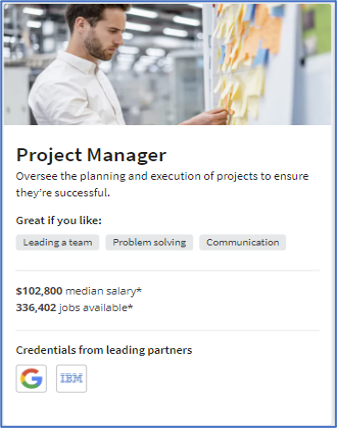
BAN 6500 - Methods in Project Management This course combines project management topics with modern methods of software support. You will learn about initiating, planning, executing, monitoring/controlling, and closing processes of predictive project management. You will also learn about Agile project management methodology and related processes. Course Restrictions: Restricted to Graduate Students.
|
 |
|
BAN 6600 - Scripting for Business Analytics This course covers the use of scripting languages, such as Python or R, for data analysis and manipulation. You will learn how to import, clean, manipulate, analyze, and visualize data using scripting languages. Upon completion of this course, you will have an understanding of the use of scripting languages for data analysis and be equipped with a valuable and in-demand skill for your future career. Course Restrictions: Restricted to Graduate Students.
|
|
|
CAPSTONE (3 Credits) |
|
|
BAN 7000 - Integrated Capstone This capstone course provides you with an opportunity to apply your knowledge and skills in business analytics to a real-world problem. Through teamwork and collaboration, you will work on a project that requires analyzing data, identifying insights, and presenting findings. This course will prepare you to be strategic thinkers and problem-solvers and provide you with valuable experience in working with data in a business context. Prerequisites: Complete all Core Courses and at least two Elective Courses under the Master of Science in Business Analytics program. Course Restrictions: Restricted to Graduate Students. |
|
ELECTIVES (9 Credits) |
|
|
BAN 6450 - Network Analytics Network analytics is used in the study of diverse structures such as the internet, interlocking directorates, transportation systems, epidemic spreading, metabolic pathways, web graphs, electrical circuits, and project plans. This course focuses on the methodological foundations which have become a prerequisite for researchers and practitioners working with network models. Course Restrictions: Restricted to Graduate Students. |
|
|
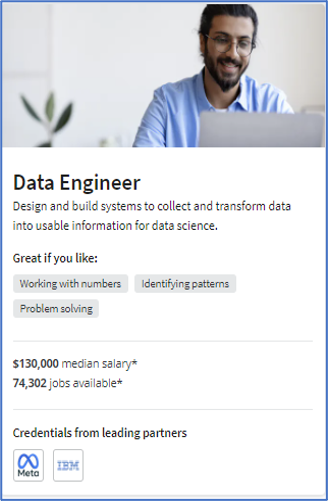
BAN 6550 - Big Data This course covers methods for the design, implementation, and management of Big Data analytics. It focuses on technologies and modeling methods for large-scale, distributed analytics. Upon successful completion of the course, you will become familiar with the fundamental concepts of Big Data management, recognize challenges, and understand how Big Data impacts Business Analytics, including proposing scalable solutions for organizations. Course Restrictions: Restricted to Graduate Students.
|
 |
|
BAN 6650 - Marketing Analytics In this course, you will gain an understanding of marketing analytics and its fundamental concepts. You will learn common methods used by marketers and learn how analytics plays a key role in digital marketing. You will explore how data are collected and analyzed for marketing purposes, as well as the privacy regulations that govern the online marketing space. By the end of the course, you will have the skills to tackle common challenges in working with marketing data and be equipped to make data-driven decisions. Course Restrictions: Restricted to Graduate Students.
|
 |
|
BAN 6910 - Special Topics in Business Analytics This special topics course addresses specialized and contemporary issues within the Business Analytics field of study. Course Restrictions: Restricted to Graduate Students. |
|
|
BAN 6990 - Internship Internships provide applied, experiential learning opportunities so you can make connections between academic study and the practical application of that study in a professional work environment. Academic internships are supervised by a faculty member and an on-site professional supervisor. All academic internships must be approved in advance by the department or program. Unless stipulated otherwise by the department or program, credit hours are defined by the university's credit hour policy. Internships may be repeated for a total of 9 credit hours. Prerequisite: At least a 2.7 GPA for undergraduate level and a 3.0 for graduate. Course Restrictions: Restricted to Graduate Students. |
|
|
BAN 6997 – Directed Readings in BAN Directed individualized topics. Course content will vary as set forth in an approved syllabus. May be repeated when the content has changed. Repeatable for up to 6 credits if content has changed.
|
|
Fall Semester Entry
|
Fall 1st 8-week term (6 credits) |
|
|
Fall 2nd 8-week term (6 credits) |
|
|
Spring 1st 8-week term (6 credits) |
|
|
Spring 2nd 8-week term (6 credits) |
|
|
Summer 1st 8-week term (6 credits) |
|
Career Outlook
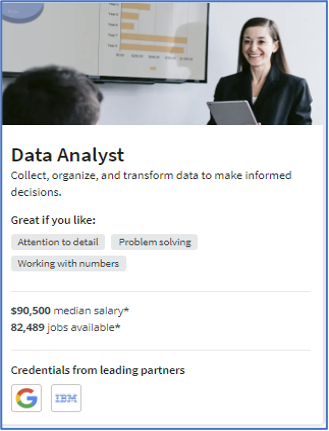
Organizations across industries continue to invest in analytics, artificial intelligence, and data-driven decision-making. According to national labor market data, data analysts earn average salaries ranging from approximately $75,000 to $85,000 annually, with compensation varying based on experience, industry, and geographic location. Professionals with analytics expertise may pursue opportunities in healthcare, finance, technology, government, consulting, operations, and marketing.
Last reviewed: June 2026
- Median Pay: $91,290
- Growth Rate: 21%
- Median Pay: $112,590
- Growth Rate: 34%
Business and Financial Occupations
- 963,500 projected openings annually
- Median wage: $80,920
- Includes Financial Analysts, Management Analysts, Market Research Analysts, Logisticians, and Project Management Specialists
Data analyst vs. data scientist: What’s the difference?
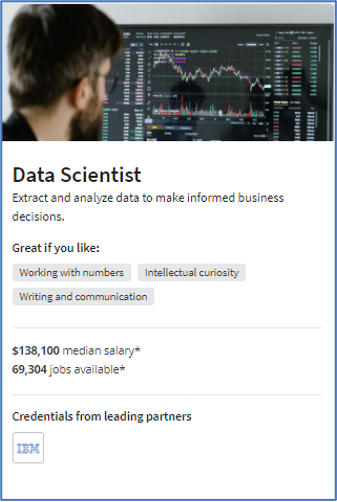
Data analysts and data scientists both work with data, but what they do with it differs. Data analysts typically work with existing data to solve defined business problems. Data scientists build new algorithms and models to make predictions about the future.
Here’s what many data analysts do on a day-to-day basis:
- Gather data: Analysts often collect data themselves. This could include conducting surveys, tracking visitor characteristics on a company website, or buying datasets from data collection specialists.
- Clean data: Raw data might contain duplicates, errors, or outliers. Cleaning the data means maintaining the quality of data in a spreadsheet or through a programming language so that your interpretations won’t be wrong or skewed.
- Model data: This entails creating and designing the structures of a database. You might choose what types of data to store and collect, establish how data categories are related to each other, and work through how the data actually appears.
- Interpret data: Interpreting data will involve finding patterns or trends in data that could answer the question at hand.
- Present: Communicating the results of your findings will be a key part of your job. You do this by putting together visualizations like charts and graphs, writing reports, and presenting information to interested parties.
Join HPU's Strong Alumni Network
Recent MSBA graduates enjoy rewarding careers at companies around the world, including:
-
Accenture
- Amazon
- American Savings Bank
-
Aston Hotels & Resorts
-
AvePoint
-
BAE Systems
-
Bank of Hawaii
-
Booz Allen
- Charles Schwab
- City and County of Honolulu
-
Decision Research Corporation
- Dell
-
Hawaii National Bank
-
Hawaiian Tel
-
HMSA
-
Microsoft
-
State of Hawaii
-
Telenor
Success comes naturally to HPU MSBA alumni, including:
- Farani Lucero – Senior Web Application Developer at eCivis
- Mieko Miyazaki – Systems Analyst at Hawaii National Bank
- Francis Montenegro – Associate Software Engineer at Accenture
- Manuel Pulido – Lieutenant Colonel, United States Army
- Zach Thorpe – Operations Manager at Amazon Web Services
- Sukru Tunca – Business Analyst at HMSA
- Randy Williams – Director of ACS at AvePoint
- Anze Znidarsic – Senior full-stack HTML5, JavaScript, and PHP Engineer at Flycom d.o.o
Frequently Asked Questions
Q: What can I do with a Master's in Business Analytics and artificial intelligence?
A: A Master of Science in Business Analytics prepares graduates to analyze data, generate business insights, and support strategic decision-making across organizations. Career paths may include business analyst, data analyst, business intelligence analyst, operations research analyst, marketing analyst, healthcare analyst, supply chain analyst, and consulting roles. Analytics skills are increasingly valued across industries as organizations rely on data to improve performance and inform decisions.
Q: Is the HPU MSBAAI program online or in person?
A: Starting in Spring 2027, the Master of Science in Business Analytics will be offered in an online hybrid format designed to support working professionals and graduate students.
Q: Can I complete the MSBAAI while working full-time?
A: Yes. The MSBA is designed with working professionals in mind. Many students successfully balance full-time employment while completing the program. Flexible scheduling allows students to pursue graduate education while maintaining professional and personal commitments.
Q: Do I need a technical background to succeed in the MSBAAI?
A: No. Students enter the program from a variety of academic and professional backgrounds. While an interest in data and problem-solving is helpful, the curriculum is designed to develop both technical analytics skills and business decision-making capabilities throughout the program.
Q: What analytics tools and software will I learn?
A: Students gain experience with industry-relevant analytics and business intelligence tools, including Tableau, Altair RapidMiner, IBM technologies, SQL, and other data analysis and visualization platforms. Coursework emphasizes practical application of analytics tools to real-world business challenges.
Q: How long does it take to complete the MSBAAI?
A: Full-time students can complete the program in 21 months.
Q: What industries hire MSBAAI graduates?
A: Analytics professionals are employed across a wide range of industries, including healthcare, finance, technology, tourism and hospitality, government, consulting, marketing, and supply chain management. Organizations in nearly every sector rely on data-driven decision-making and seek professionals with analytics expertise.
Q: What makes HPU's MSBAAI different from other analytics programs?
A: HPU's MSBA combines a business-focused analytics curriculum with applied learning experiences, personalized faculty engagement, small class sizes, and a global perspective informed by Hawai‘i's location in the Asia-Pacific region. Students also have opportunities to earn industry-recognized credentials through coursework and gain access to Coursera Career Academy resources.
Q: How much does the HPU MSBAAI cost?
A: All costs can be found at hpu.edu/costs. HPU offers competitive graduate tuition and financial aid opportunities for eligible students. Military-connected students may also qualify for education benefits and additional funding opportunities.
Q: What are the admission requirements for HPU's MSBAAI program?
A: Admission requirements include a completed online application, $55 fee, and official transcripts (bachelor’s degree or higher). No GRE is required. Optional materials include letters of recommendation and a personal statement or essay.