

-
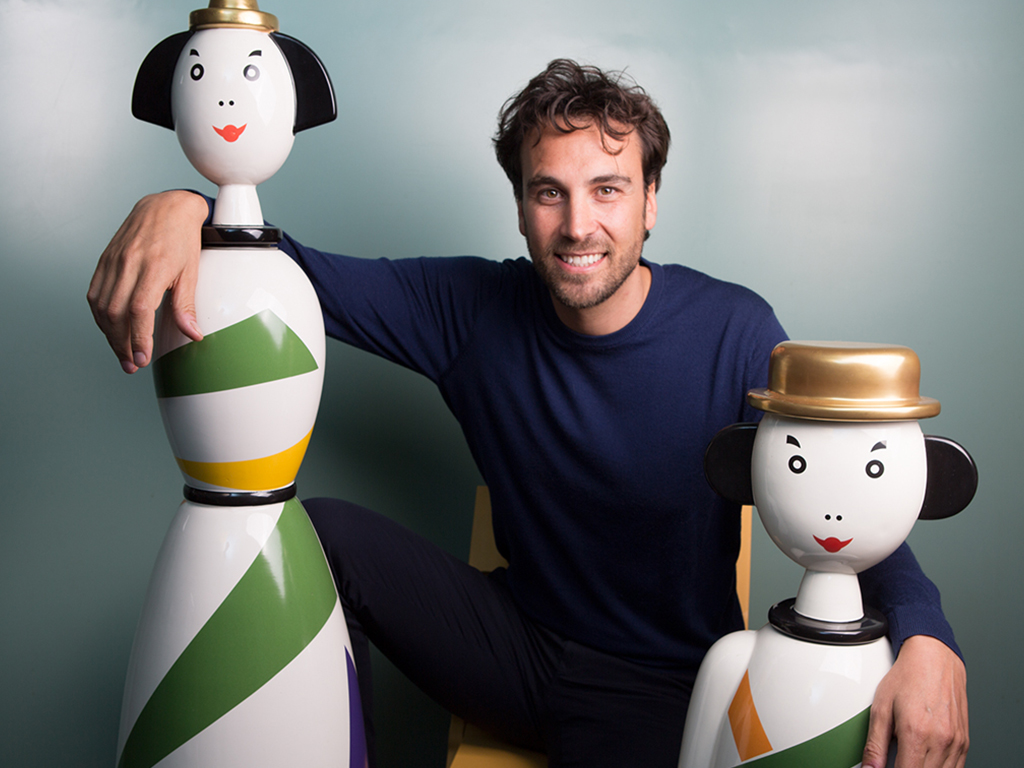
Luca Alessi.
-
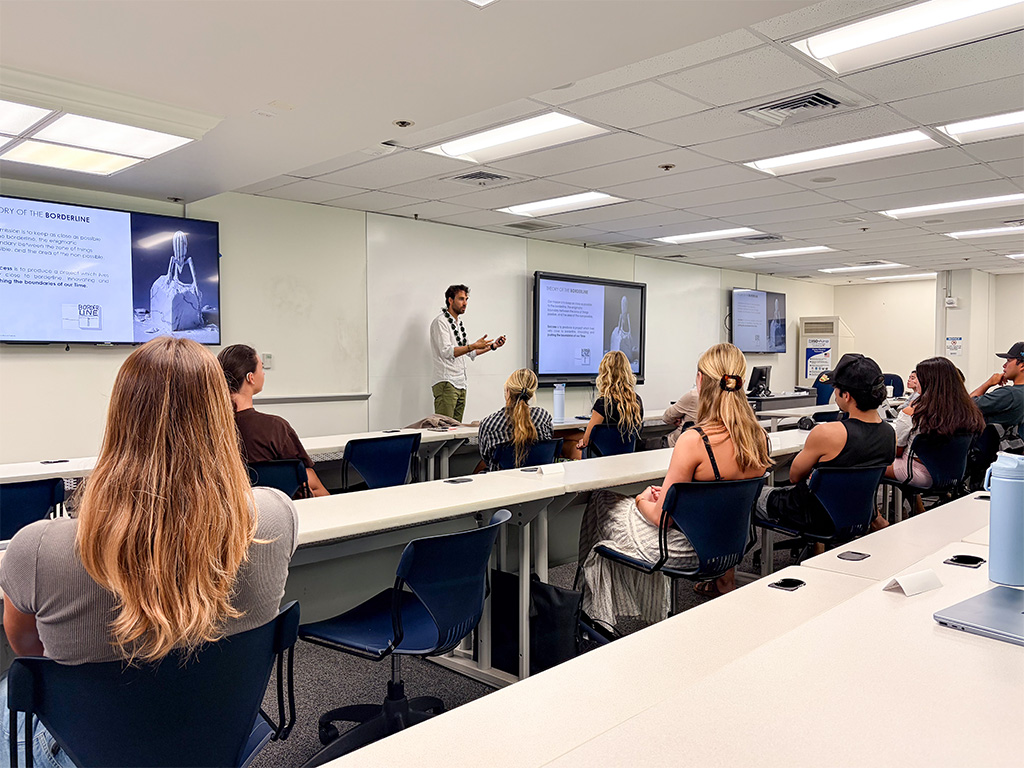
Luca Alessi returned to HPU in spring 2026 and spoke to a classroom of marketing students.
-
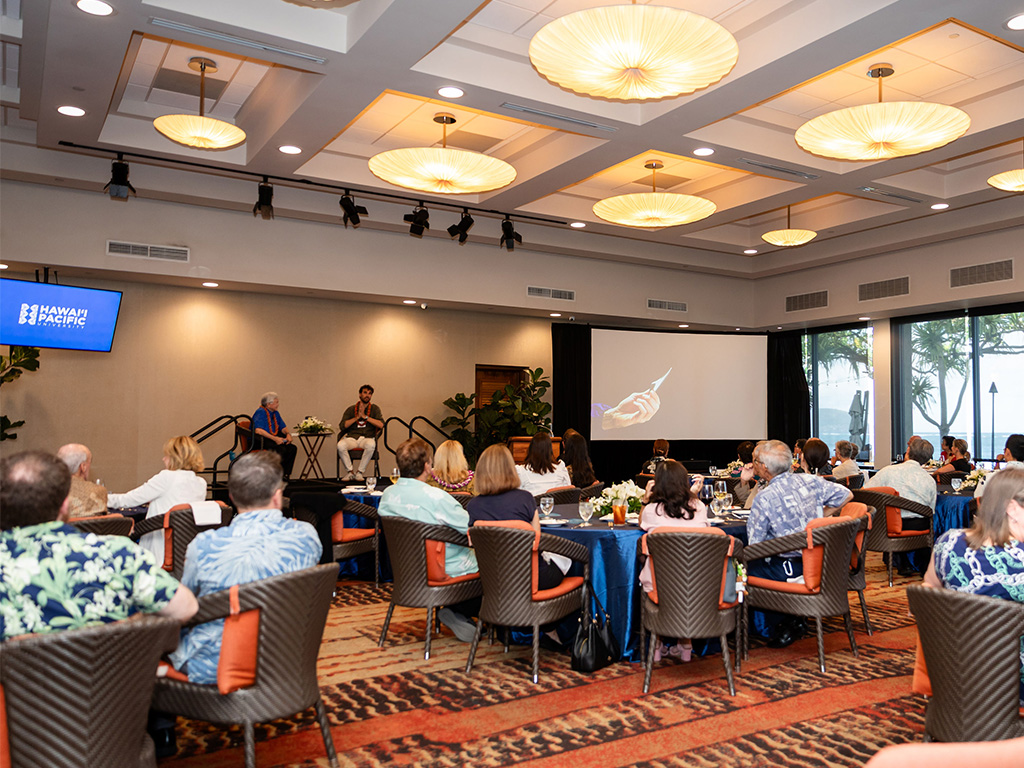
Luca Alessi spoke at HPU's Distinguished Speaker Series event in April 2026.
Fermiamoci un momento. Imagine a design company that uses no focus groups and bases its decisions on whether the product will spark joy. Success is not how many units are sold, but rather, did the product brighten your day? This Italian dream factory is not new invention, but over 100 years old, designing over 1,400 products as wide-ranging as a fruit squeezer to a tablet computer (yes, before the iPad).
It's one of the world's most iconic design companies, with a mission to sell you a product you didn't even know you wanted. The only thing you know is that it brings you pure happiness. You may never use that fruit squeezer; its iconic design borrowed from baby octopuses. Anyone at Alessi will all tell you that is the point. Their products are artistic statements, conversation starters for your home, pieces of rare craftsmanship that carry their own story and personality. But in a twist, Alessi's encyclopedic catalog of products are all meant to be used, repeatedly, for a lifetime.
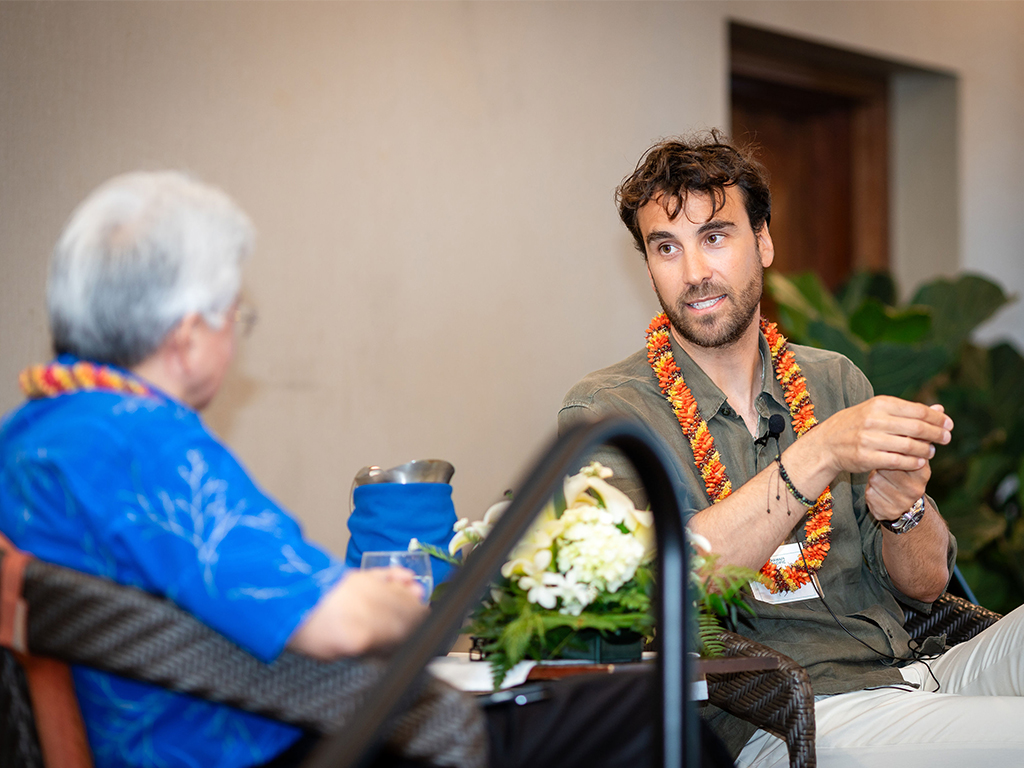
Luca Alessi (right) and HPU President John Gotanda (left) at the HPU Distinguished Speaker Series Event in April 2026.
Four generations into Alessi's 105-year existence, the work of pushing boundaries belongs in part to an HPU alumnus who recently came back to a place he has loved for over 20 years.
Luca Alessi, Commercial Director and Head of Business to Business and Strategic Partnerships at Alessi, returned to HPU this spring to speak with business students at Pioneer Plaza and to headline the HPU Distinguished Speaker Series event.
An hour north of Milan, the plain breaks against the foothills, and they gently rise into the Alps where lakes appear, long fingers of glacial water held between the mountains. The Alessis are from the Italian lake country and have been for generations. This is where the dream was born.
"Where to begin? At the start, of course,” Luca said, a smile and laugh filling the room. “I was born in Milan and raised at Lake Maggiore.”
Lake Maggiore is its own small world. It is west of Lake Como and runs some 60 kilometers north into Switzerland, ringed by Belle Époque hotels, terraced gardens, and small alpine towns where Italian and Swiss sensibilities meet. Just over the ridge to the west sits Lake Orta and the town of Omegna, the heart of what Italians call the distretto dei casalinghi, the housewares district, where Alessi, Bialetti, and Lagostina all grew up within a few kilometers of one another. It is a place where industrial craft is not an oxymoron. The same mountain villages that turn out enameled cookware and stovetop espresso makers also produce architects, winemakers, and designers. To grow up there is to grow up inside a tradition that takes everyday objects seriously, as expressions of taste.
Luca knew early on that he wanted to study business and to join the family company. He enrolled at Bocconi University in Milan for his undergraduate studies, one of the most respected business schools in Europe, an hour drive from home. While there, he traveled to HPU for a semester abroad, looking for a place to live in another language and really test himself.
He landed in Honolulu and was immediately captivated by the islands and their culture.
"It is very different from Milan, and all of Italy,” he shared. “Hawaiʻi is diverse. I was in a multicultural environment that I loved right away. When I landed, I felt at home. The aloha spirit and ʻohana you feel right away! It's true. I fell in love with Hawaiʻi and the dreams here."
After finishing his last exam at Bocconi on a Friday in September 2008, Luca flew back to Honolulu the following Monday to begin his MBA at HPU. Where Bocconi had been theoretical, HPU was rooted in practical curriculum, full of group work, real-world experiences, and presentations.
"HPU gave me such a strong foundation in real world experiences," Luca said.
That foundation now sits inside one of the most inventive companies in the world. By size, Alessi is small to medium: roughly 300 employees, a factory in Italy, a presence in 110 countries, a handful of monobrand stores, and on shelves in places like Bloomingdale's. By philosophy, it is something else entirely. Luca tells the story as his family story, beginning in 1921 in Omegna, when his great-grandfather Giovanni opened a workshop that specialized in brass, copper, and nickel silver metalware.
"The only way to stay successful is to evolve," Luca said. "You cannot stay one way forever. You can maintain your heritage and your vision, but you need to evolve. The second generation, my grandfather Carlo and his younger brother, made the company very successful, producing high-quality products for Italian homes. We were in a small area where people specialized in working with certain materials. In Venice, people specialize in glass. In our area, it was metal."
The third generation came around, in the 1970s, and they decided that metal could carry something else. Dreams. They started commissioning artists to design useful objects for the home, starting with a collaboration with Salvador Dali. The Dali project was a commercial flop. Almost nothing sold. But it gave the spark, Luca said, of what Alessi is today. The Alessi DNA.
Today, Alessi is recognized around the world as a design house, but no designer works there. Instead, they collaborate with more than 300 designers across the globe, from well-known names to recent graduates, on the theory that creativity is too big to live inside one mind. Luca calls the company a mediator, in the business of fulfilling the dreams of the people.
In place of focus groups, Alessi works by intuition, guided by what Luca calls the borderline theory. He drew an imaginary line on the table.
"On my side is the world of not possible," he said. "On your side is the world of possible. If a company launches a product that falls in the world of not possible, people do not understand it, they do not like it, they do not buy it. If it falls on the side of possible, they understand it, they like it, they buy it. Most companies stay very far from the line. They are deep in the world of possible. But that means there is no innovation. The products are the same. It becomes very boring. Alessi wants to work as close as possible to the borderline, pushing the line further away, so that what is not possible slowly becomes possible. This is our dream, our mission."
The lemon squeezer is the proof. Designed in the 1980s, tripod legs splayed like a baby octopus, it has sold in the millions. On the 25th anniversary of its release, Alessi published a book about it titled 25 Years Without Squeezing a Lemon, an honest wink at the fact that almost nobody who owns one uses it on a lemon. People buy it, Luca said, for the way it makes them feel. That is the magic of Alessi. Products that people do not know they want until they see them.
That magic only works inside a value system, and Alessi has staked one out clearly. "Most traditional companies look at profit as the sole goal," Luca said. "At Alessi, profit is important, yes, but product, people, and our planet are all on the same level. We protect our people and our planet. Sometimes we launch products that are an artistic statement. We have fifty museums that hold our pieces in their permanent collections. This vision allows us to be a B Corporation. The company is not a tool to benefit from profitability, but to give meaning to the world and to protect the planet."
Alessi's mission, in Luca's words, is to bring art and poetry into our daily lives. Design is a new form of art and poetry. When people see and use their products, they feel better. Life is happier. That is the point.
The partnerships Luca oversees are the philosophy applied. Mass-production companies bring scale and engineering. Alessi brings aesthetic and design. Together they have made watches with the Seiko Group, pencils with Mitsubishi, and the Panda, a car with Fiat. In 2007, three years before the iPad, Alessi released a tablet computer called "Alessi Tab." The technology was not ready, and the product never found its market. Sometimes the borderline pushes back.
Apple itself has a place in the Alessi story. Before joining Apple, Ron Johnson, the executive recruited in 1999 to build the first Apple Stores, had developed his design philosophy partly through an Alessi presentation at a housewares fair in Frankfurt, where pots and juicers were displayed as works of art. "It was like walking through a museum," Johnson recalled in the 2013 Italian magazine profile. "They weren't there to make money, but to create fantastic products."
All of this was what Luca brought with him to Pioneer Plaza. The classroom was packed, about 30 students, and the questions flew around the room. They asked about the famous Alessi encyclopedic catalog and how Alessi made the leap from manufacturer to iconic design company.
"I want to give students a different point of view on how to run a company," Luca said. "I remember when I was in their shoes."
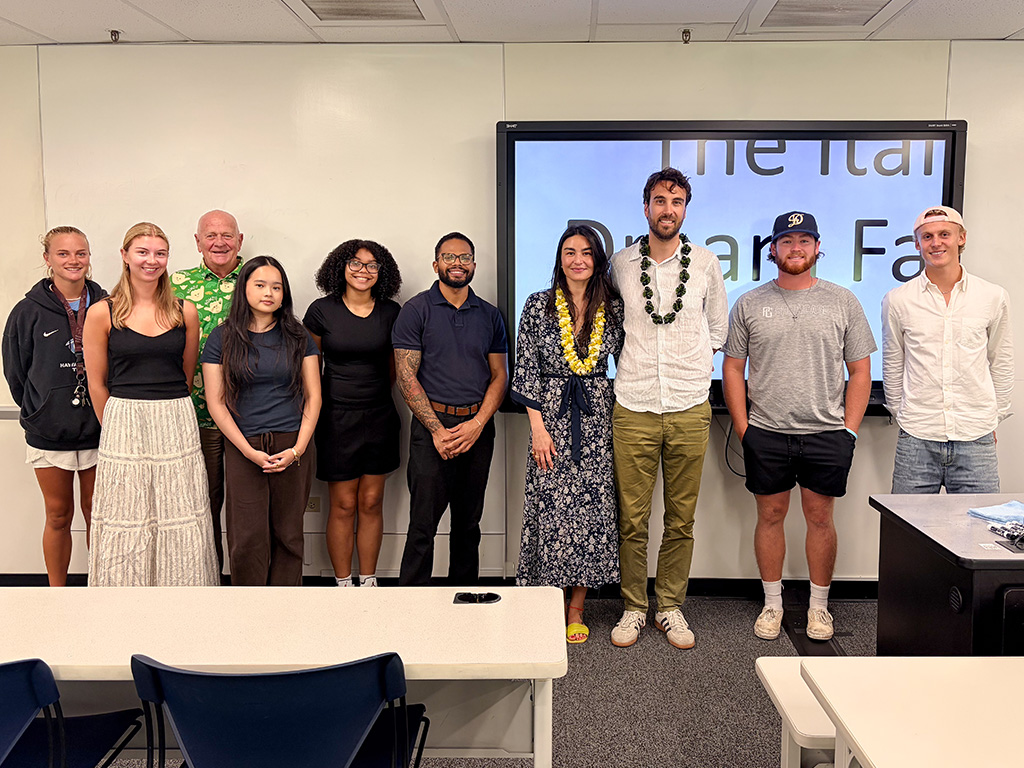
Luca Alessi (third from right) with his wife Juliana Ogliari (fourth from right) with HPU marketing students.
One question landed close. A common fear among younger people, the student said, is the fear of making mistakes. How does Alessi handle that?
Luca's answer was a smaller version of the borderline theory. "You make mistakes in business, and that is okay. There are no real mistakes in life, because you must learn from them, and then they become a lesson."
The Dali project was a so-called flop that eventually became a doorway. The Alessi Tab arrived years before the market that could have ever wanted it. Mistakes in the world of the not yet possible are not really mistakes. They are the future arriving early.
Later, at the HPU Distinguished Speaker Series event, Luca traced the same arc for a different audience: business leaders, alumni, faculty, friends of HPU. The substance was the same: the family story, the borderline theory, the conviction that an inventive company can stand for art and poetry rather than for profit alone. The frame was different. To the students at Pioneer Plaza, he spoke as someone urging them past their fear of being wrong. To the room at the Distinguished Speaker Series, he spoke as a fourth-generation leader making the case that a small Italian company can run on a different operating system than the rest of the global market and still grow.
He has lived inside that operating system for 13 years now. Six in Hong Kong, three in New York, then back to Italy in 2017, where he built out Alessi's omni-channel direct-to-consumer business. Every Alessi product, he said, has a story to tell, and the stores exist to tell them.
The future, by Luca's telling, is more of the same vision, carried forward by people who are not yet in the room. "The vision of creating products that touch your emotions must be the core DNA of the company for the next one-hundred years," he said. "The work we do with new talent is huge. There are always more talented designers to collaborate with. What will be the next dream product that we cannot even think of?"
When asked, at the end of our conversation, what a good life looks like, his answer sounded less like the philosophy of a company and more like the philosophy of a man who has spent his life pushing at the borderline between possible and not.
"I like to challenge myself, starting new things, putting myself into a situation where I must learn. I want a life rich with experiences that leaves you in a calm environment. Always challenge yourself, because that makes you grow, both personally and professionally. And it always helps the soul to be on a beach, or by a lake. Water lets the dreams in."
"I segreti degli Apple Store," Mac Magazine (Italy), July 1, 2013, p. 25. Translated from Italian.