

-
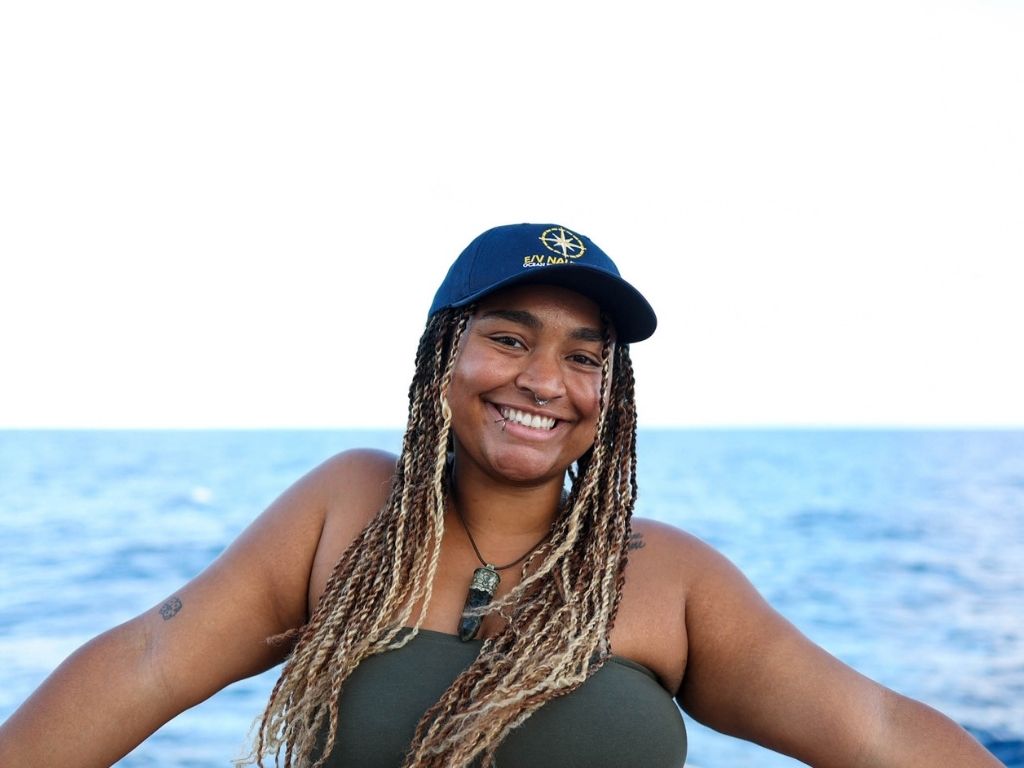
HPU alumna and Lecturer of Marine Science Nneamaka Ogbaekwe aboard the Exploration Vessel Nautilus during a June 2026 expedition from Honolulu to Guam.
-
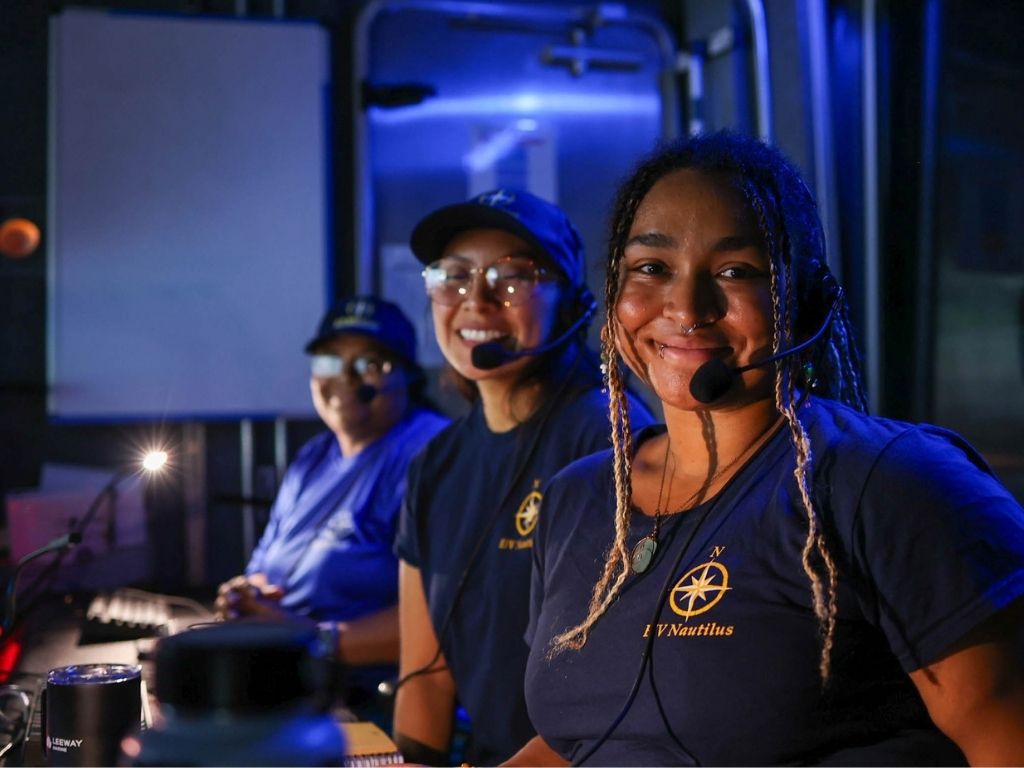
Ogbaekwe, foreground, works alongside fellow Nautilus team members in the ship's control room.
-
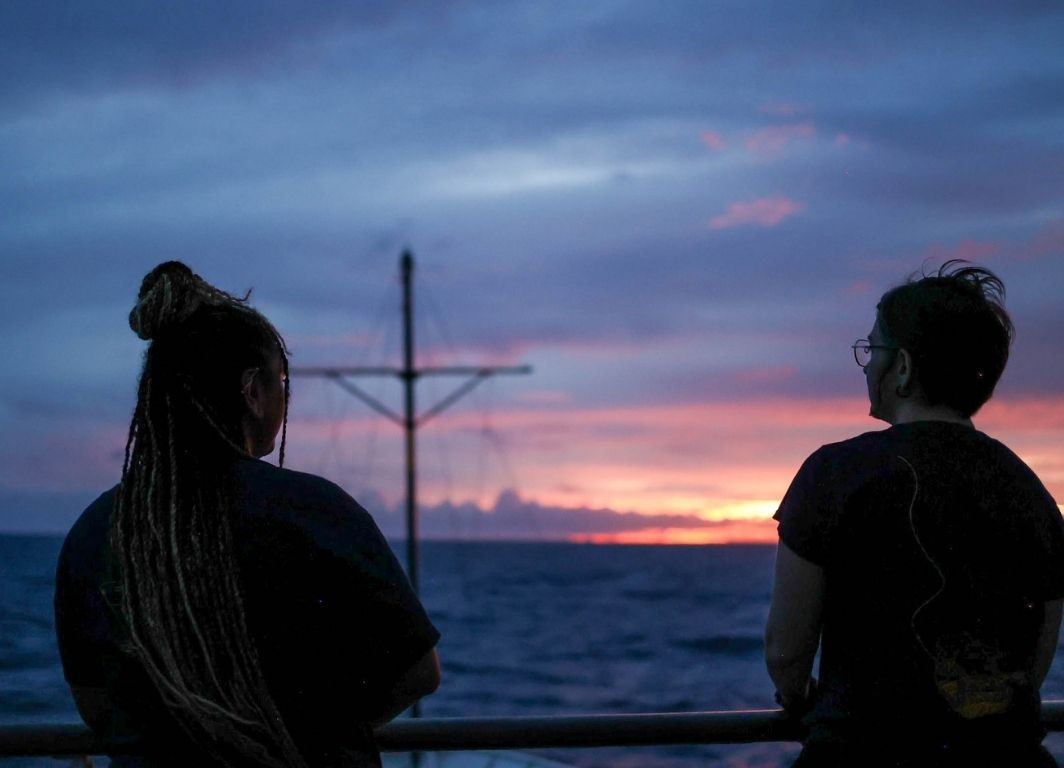
Ogbaekwe, left, and a fellow team member watch the sunset in the Pacific Ocean.
When Hawai‘i Pacific University Lecturer of Marine Science Nneamaka Ogbaekwe stepped aboard the Exploration Vessel (E/V) Nautilus in June, she thought her experience teaching and conducting fieldwork on HPU’s research vessel, the Kaholo, had prepared her for life at sea.
And it did, but the experience aboard the Nautilus was different from what she expected.
“Simply boarding that type of vessel was extremely different to how you get onto the Kaholo,” Ogbaekwe said. “It was a very surreal moment getting onto a vessel that is so large that it’s housing 50 people.”
Her arrival on the Nautilus marked the beginning of a two-week expedition, from June 10 to June 24, that took Ogbaekwe roughly 3,000 miles from Honolulu to Guam and gave the HPU alumna a firsthand look at deep-ocean exploration alongside scientists, engineers, educators, and crew members.
Ogbaekwe was selected from hundreds of applicants as a 2026 Science Communication Fellow by Ocean Exploration Trust (OET). She joined a cohort of 14 educators from schools, science centers, and nonprofit organizations across the Pacific and North America. The fellowship places educators aboard the Nautilus to participate in expeditions while developing their science communication skills and finding ways to bring ocean exploration back to their students and communities.
“Typically, K-12 educators are selected for this fellowship, so it was an honor to be chosen as a university faculty member and researcher,” she said.
The experience provided Ogbaekwe new technical knowledge, a broader perspective on working at sea, and firsthand lessons she can now share with her HPU students.
Mapping the Pacific Aboard E/V Nautilus
The expedition focused largely on mapping a stretch of Pacific seafloor between Hawai‘i and Guam that had never before been mapped in high definition. It was also the first expedition to use a new acoustic multibeam mapping system aboard the Nautilus.
Ogbaekwe watched the mapping take place as the vessel moved through areas where existing information showed indications of underwater features. As new data appeared, she could see much greater detail.
“You would see something that looks just like a little mound,” she said, “and then there would be features that looked sharp or jagged on the high-definition map. We saw details that we would not be able to see in lower definition.”
Being a part of that process was particularly meaningful to Ogbaekwe, who worked with mapping as part of her master’s thesis project at HPU.
“It was really cool to get to be a part of adding to that global data set,” she explained.
The new sonar system was another major part of the experience. Representatives from the company that created the instrument were aboard the Nautilus, including people who worked on its programming.
“I learned so much information,” she said. "It was really interesting to dive in and learn from experts in the field and the people who developed the technology we used.”
Ogbaekwe said those conversations ranged from how the sonar worked to wavelengths, coding, and the programs used to display the information that was being collected.
The system also allowed the team to see information at greater depths than the vessel’s previous instrument. Ogbaekwe recalled watching it continue to produce information down to approximately 10,000 meters.
“We were all just staring at the TV screens in awe,” she said.
Lessons from Life at Sea
Not all of Ogbaekwe’s takeaways involved technology. The expedition also reinforced something she learned during her own time as an HPU student and later as a faculty member.
“Everyone had something to contribute to the expedition,” she explained. “Being adaptable and being able to work with all types of people is probably the biggest lesson that I learned at HPU that became relevant on the ship.”
Those interactions also exposed her to areas outside of her usual focus. Seabird surveys were among the activities included in the trip, and Ogbaekwe spent a lot of time with two ornithologists on board.
She jokingly described herself as becoming an “amateur birder” during the voyage. “I’m very firm about not being a biologist. I’m an oceanographer. But then I became a little birder on this trip.”
The experience has since inspired her to work on a native Hawaiian seabird lesson that she hopes to introduce to her environmental science students in the spring.
Some of her strongest memories, however, came during quieter moments aboard the vessel. Early in the expedition, Ogbaekwe went to the uppermost “monkey deck” at night. With the lights turned off on the ship, she could watch the Milky Way drift above her.
“We were out in the middle of the ocean, and it literally felt like I was inside of the galaxy. It was so beautiful,” she said.
Bringing Ocean Exploration Back to HPU Students
Ogbaekwe teaches General Oceanography, General Oceanography Lab, Ocean Biology Lab, and First Year Seminar at HPU. She has also focused on helping to prepare students who are interested in becoming seagoing scientists.
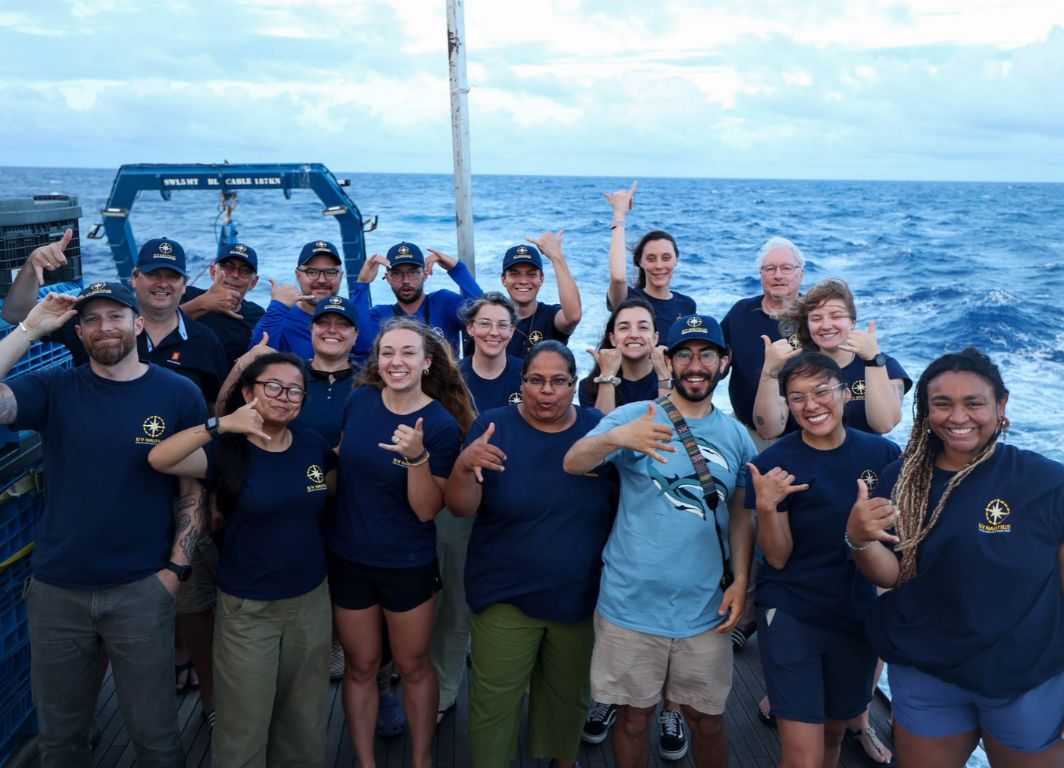
Ogbaekwe, front right, poses with fellow expedition participants.
Her time aboard the Nautilus gave her a clearer sense of what those students may need when working on a larger research vessel, particularly when it comes to instrumentation, understanding individual roles, and communicating with others.
“I feel I just have more insight into the process for my students,” she said. “I know what I should be pushing them on so that if they want to pursue a career as a seagoing scientist, they have a stronger background by taking what I’m already teaching them and putting it into context on a bigger scale.”
The expedition also reinforced the value of speaking up and asking questions. Ogbaekwe explained that some of her students can be timid, and she regularly encourages them to become more comfortable communicating with those around them.
“You can learn so much from everybody on board any vessel. I just need to keep pressing that lesson, so my students feel more confident,” she said.
Some outcomes from the fellowship will also translate directly into new teaching materials. Ogbaekwe is developing a new collegiate-level ArcGIS mapping lesson plan and anticipates incorporating what she learned about sonar and the programs used aboard the Nautilus into her courses.
Expanding Her Path in Marine Science
The fellowship also came at an important point in Ogbaekwe’s career. Since joining the HPU faculty, she has largely focused on establishing herself as a lecturer. Applying for the Science Communication Fellowship gave her an opportunity to explore something different.
“It expanded what I thought I was capable of doing,” she said. “I feel like I have more hands-on experience now. "I like to consider myself an official ocean explorer.”
Ogbaekwe had previously thought about following a more traditional academic path that included pursuing a Ph.D., but the fellowship showed her another way to combine her experience as a marine scientist and educator through science communication.
“It shifted my own views on myself and has definitely motivated me to put myself out there for more opportunities that I wouldn’t have thought I was qualified for before,” she explained.
After completing the expedition in Guam, Ogbaekwe returned to HPU still “piecing together exactly what I want to incorporate into my classroom.”
She already has plenty to draw from: new knowledge about sonar and mapping, a better understanding of life aboard a large research vessel, and firsthand experience as part of an ocean exploration team.
All photos by Marley Parker