

-
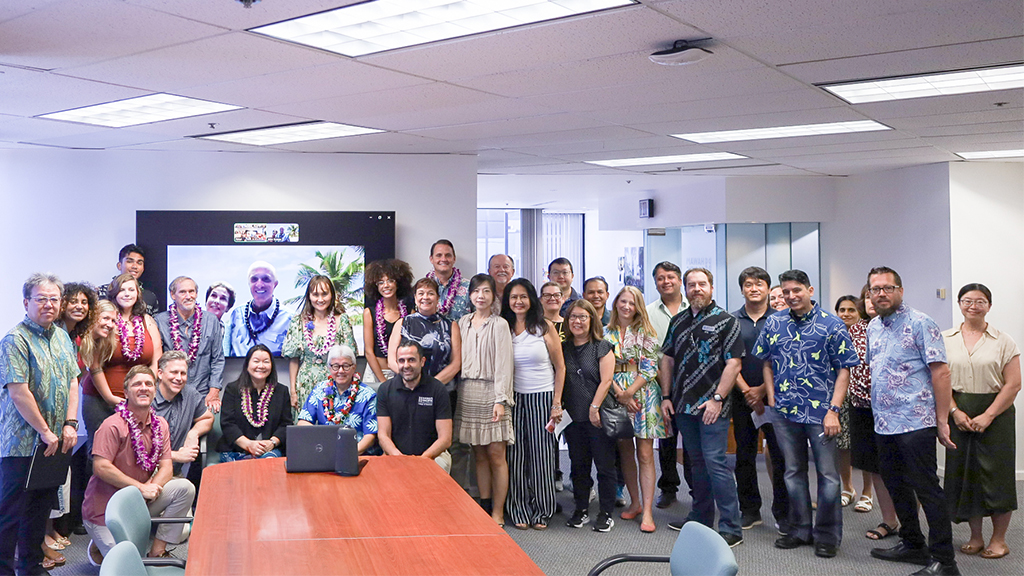
John F. Scarpa (seen on monitor) joined HPU President John Gotanda (seated, behind laptop) and members of the HPU 'ohana virtually for the plaque ceremony.
-
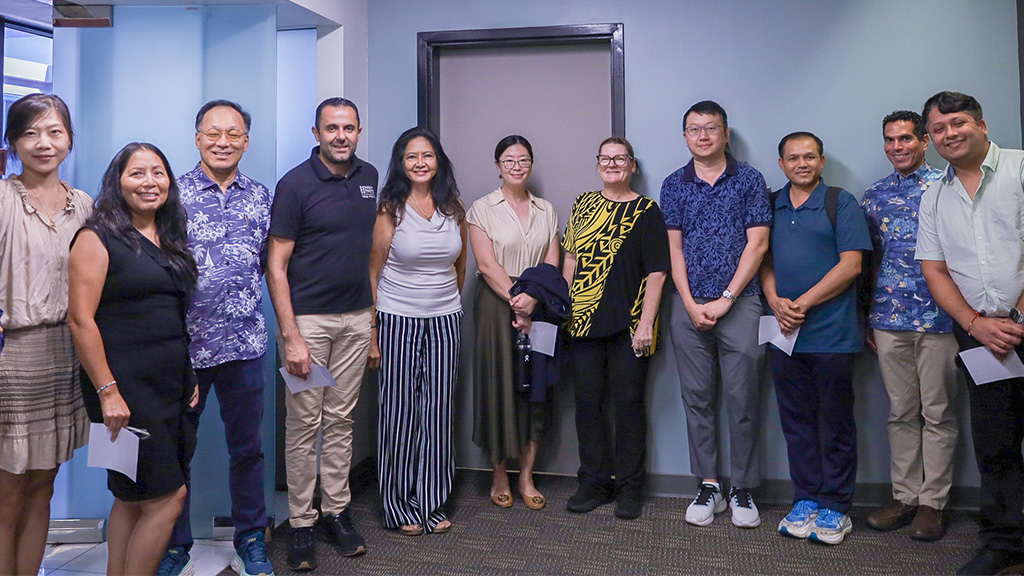
HPU College of Business faculty and staff.
-
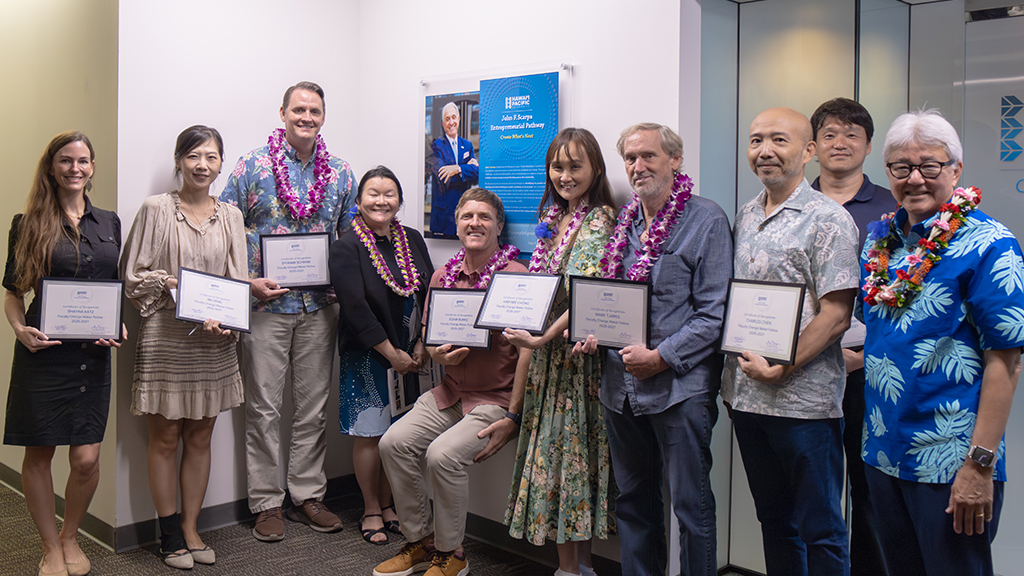
Scarpa Faculty Change Makers with HPU President John Gotanda (far right).
-
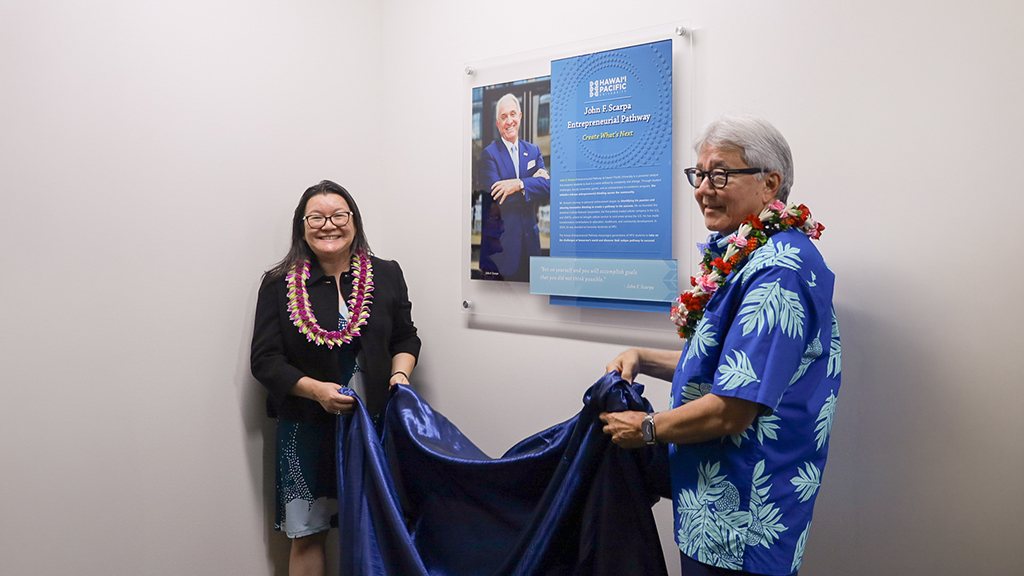
Dean Amy Nguyen-Chyung and HPU President John Gotanda unveiled the John F. Scarpa plaque at the HPU College of Business.
-
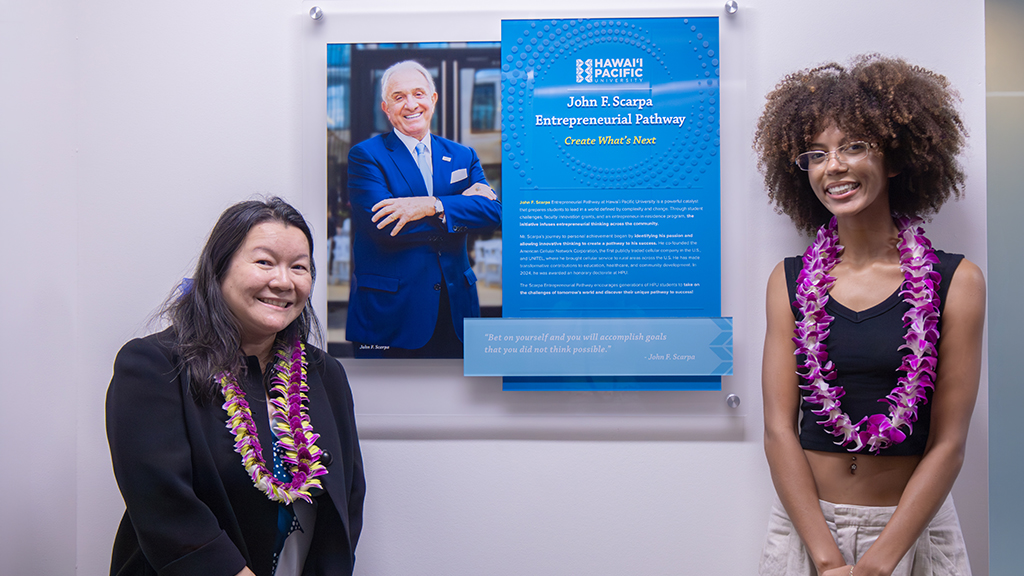
Dean Amy Nguyen-Chyung and Jenna Bond.
A plaque bearing the name of visionary entrepreneur and philanthropist John F. Scarpa now hangs at HPU, but the real story behind it is already being written by the students and faculty who have taken part in the opportunities his transformative $700,000 gift made possible.
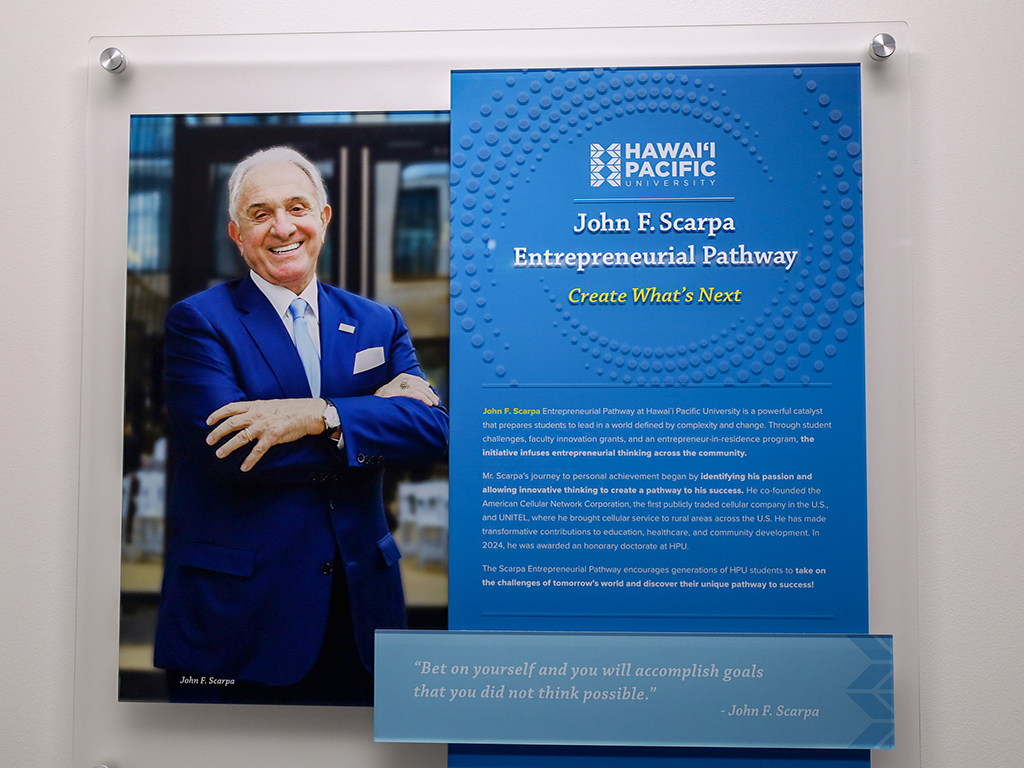
The John F. Scarpa plaque is located in the HPU College of Business at Waterfront Plaza.
Speaking by Zoom to a gathering of students, faculty and staff on Sept. 18 at the HPU College of Business at Waterfront Plaza, Scarpa said he hoped the John F. Scarpa Entrepreneurial Pathway would do more than teach students how to start a business.
“My hope is that this Pathway becomes a spark, for ideas not yet imagined, for solutions to problems not yet solved,” he said.
Just over a year after Scarpa made his gift to establish the Pathway at HPU, the early results are beginning to take shape in a profound way. In its first full year, more than 200 students have engaged with the Pathway, more than 40 new venture ideas have been pitched, 11 faculty members have been funded, and 41 events have been held.
“All of this before we have had the chance to dedicate your plaque,” said HPU Dean of the College of Business Amy Nguyen-Chyung, Ph.D., MBA-MPA.
HPU President John Gotanda shared that the idea at the heart of entrepreneurship is simple: seeing an opportunity where someone else might see a problem.
“One of the key attributes of an entrepreneur is the willingness to see possibilities where others may not,” Gotanda said. “Most people see problems and complain, but entrepreneurs see problems and they say, ‘these are opportunities.’”
That creative way of thinking is finding its way into HPU’s classrooms and laboratories.
Through the inaugural Scarpa Faculty Change Makers Fellowship, eight projects were selected from 19 proposals, representing every college at the University. More than $50,000 was awarded to faculty members who are bringing entrepreneurial thinking into their courses in very different ways.
For Associate Professor Adam Burke, Ph.D., and Adjunct Faculty Member Ephraim Schwab, Ph.D., in the College of Liberal Arts, that meant rethinking an honors course through the traditional Hawaiian ahupua‘a system.
Burke shared that students went into their communities, including Waimānalo, to identify sustainability challenges and develop possible social ventures. They also used generative AI and worked across disciplines as they moved their ideas beyond the classroom.
“It was through that hands-on field immersion where students stepped away from the textbook and saw that these are not just problems because I am reading about it, but also because I am doing it firsthand,” Burke said.
Schwab said one of the most rewarding parts was seeing students develop ideas that could continue beyond the course.
“The great outcomes of our course was students creating real entrepreneurial opportunities that they could engage with in life if they choose to take it further,” he said. “We really stressed within this course environmental and social stewardship.”
In the College of Professional Studies, Scarpa Faculty Change Maker, Assistant Professor Han Nee Chong, Ed.D., brought entrepreneurship into technology education through a redesigned graduate course.
“I thought, what if students could use the tools and solve their own problems?” Chong said.
The course gives students both theoretical knowledge and practical experience, incorporating tools available to HPU students, including Gemini Pro and NotebookLM.
“I wanted to give students the theoretical knowledge and also practical experience,” she said.
For some students, the Pathway has meant taking an idea that might have remained just an idea and putting it in front of a room full of people.
Michael Lozada-Longog, a sophomore biomedical engineering student, participated in the inaugural Scarpa Entrepreneurial Pathway Startup Challenge as part of the PC Tech Tracker team. The team won the $10,000 college prize and went on to represent HPU at the University of Arizona in the next stage of the Hult Prize.
“It really impacted me as a freshman biomedical engineering student,” Lozada-Longog said. “It helped me with my public speaking, pitching, and the experience overall helped me explore different innovating ideas.”
The experience also introduced him to people who encouraged him to think differently and helped him build his network.
For junior Kennedy London, the Pathway provided an opportunity to pursue a research question that began with a rather unusual subject: an introduced poison dart frog.
“I got to design a project with the introduced poison dart frog that has never been tested for toxicity,” London said. “I wrote the grant for and designed the project to test for a toxicity analysis, leading to different conservation issues as well.”
London shared that the experience could eventually become a capstone or master’s thesis. She is also one of five undergraduate students working in the laboratory of HPU Assistant Professor Jessica Jacob, Ph.D., where students gain hands-on experience with research involving zoonotic diseases and diagnostic technology.
“Being able to connect with my professors and fellow students and being able to work in a lab with my professors in my undergraduate years is unique and important,” London said.
The opportunity to present her work has been just as valuable.
“I think that public speaking is a skill that is important for all careers, and to have the experience as an undergrad is invaluable when presenting their work to a panel,” she said. “Some of those opportunities you do not get until graduate school or further in your education or career.”
And then there is the confidence that can come from stepping outside the classroom.
New graduate Jenna Bond, MBA ’26, participated in the Scarpa Startup Challenge and later received support through the Pathway to attend the 2026 East Meets West Conference. There, she connected with a potential venture partner and an experienced startup mentor.
The experience also helped lead Bond to work teaching AI to high school students and helping businesses across Hawai‘i learn how to use AI.
“It was all about empowerment, to be able to empower yourself,” Bond said. “To be an entrepreneur is to empower yourself.”
Bond hopes other HPU students will see entrepreneurship in similarly broad terms.
“I encourage HPU students to remember that you can be an entrepreneur, and it’s not only for business students,” she said. “It’s empowering to have knowledge and know how to use it and help others as well.”
That idea, that entrepreneurship belongs to more than one discipline, career or kind of student, is central to what HPU is building through the Pathway.
“At HPU, we value students who think differently,” Gotanda said. “John’s investment in the Scarpa Entrepreneurial Pathway gives HPU an opportunity to turn those visions into something real.”
For Scarpa, what students ultimately do with that opportunity is up to them.
When he first decided to make his gift, Scarpa said he wanted students to understand how entrepreneurial thinking could benefit them throughout their lives, whether they eventually became entrepreneurs themselves or worked alongside people with entrepreneurial experience.
But he also had another message for the students gathered at HPU.
“It is up to you to make your own decisions in life and determine what you want your future to be,” Scarpa said. “Your commitment, your vision, and your planning must be yours. Have the courage to follow it.”
He encouraged students to remember the people who helped them along the way, and, when they have the opportunity, to do the same for someone else.
“That to me is what makes an opportunity truly meaningful,” Scarpa said. “Not only what you accomplish for yourself, but what you ultimately do for others.”
The plaque will remain as a permanent reminder of Scarpa’s investment in HPU. But on the day it was dedicated, the more meaningful markers of that investment were perhaps elsewhere: in a student pitching an idea, a professor rethinking a course, a researcher asking a new question, and graduates discovering where an opportunity might lead.
Scarpa left the students with one final thought.
“For you, our innovators, you are the future,” he stated.
And then: “Bet on yourself and you won’t believe the success that you will have.”
All photos by Henley Baker.