

-
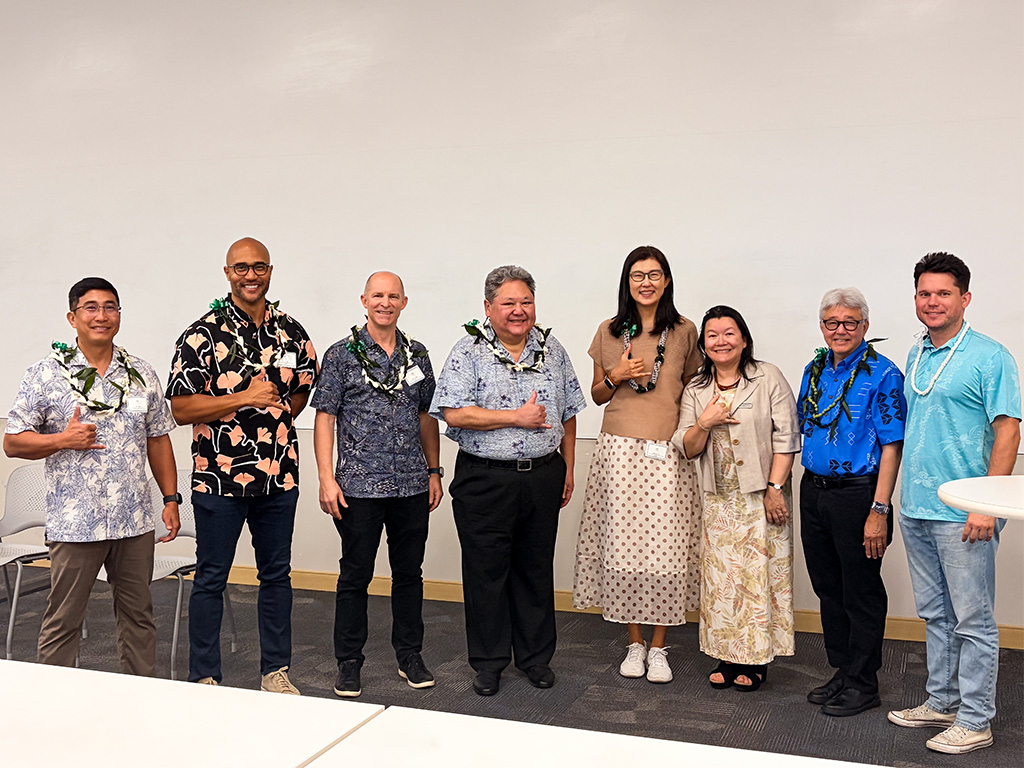
From left: Iven Sugai, Kenji Price, Jason D'Olier, Jason Higa, Rebecca Cai, Amy Nguyen-Chyung, John Gotanda, Michael Bennett pose for a photo at Hawaii Tech Week's AI Strategy Panel at HPU's Aloha Tower Marketplace.
-
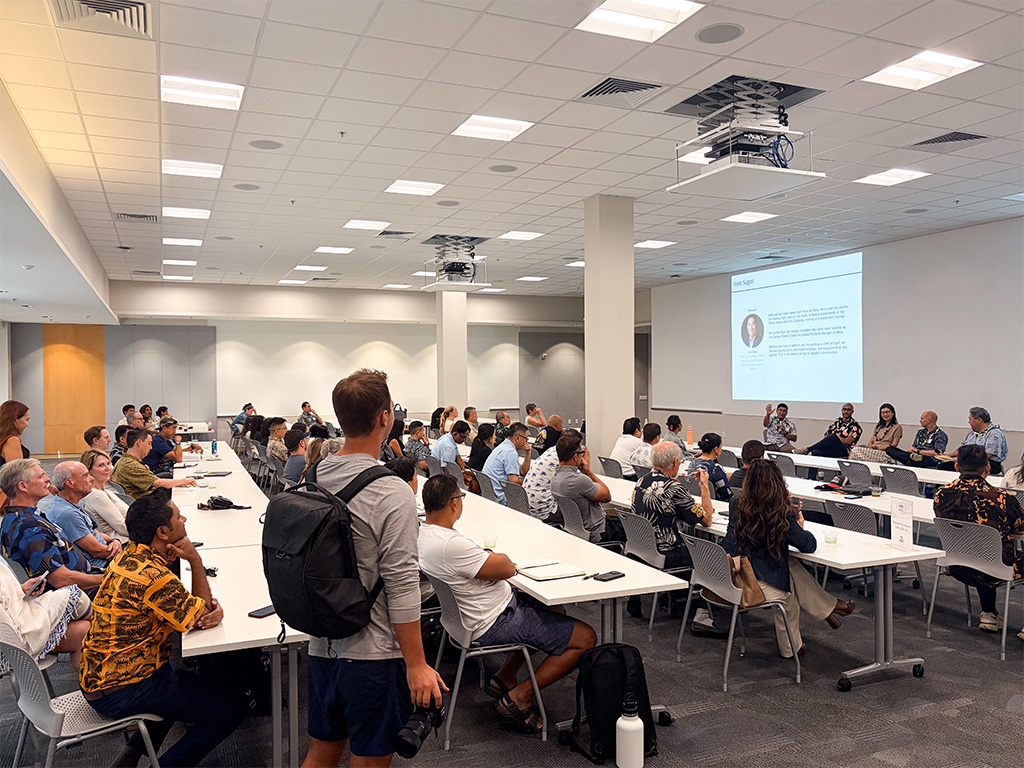
A sold-out crowd gathered at HPU's Aloha Tower Marketplace to learn about artificial intelligence strategy.
-
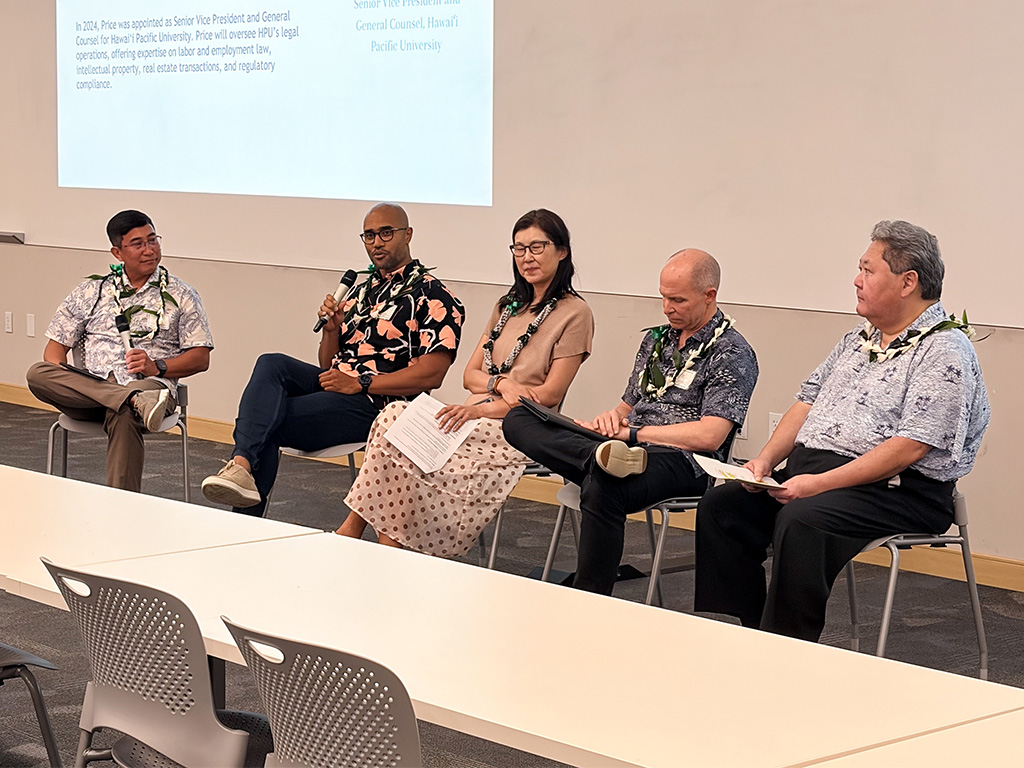
Kenji Price, second from left, answers a question during the Hawaii Tech Week AI Strategy Panel. From left: Iven Sugai, Kenji Price, Rebecca Cai, Jason D'Olier and Jason Higa.
On Sept. 2, HPU hosted a sold-out panel discussion on artificial intelligence strategy at its Aloha Tower Marketplace campus, drawing faculty, staff, students, and community members. The event was part of the third annual Hawaii Tech Week, sponsored by HPU and founded by HPU alumnus Michael Bennett, who attended.
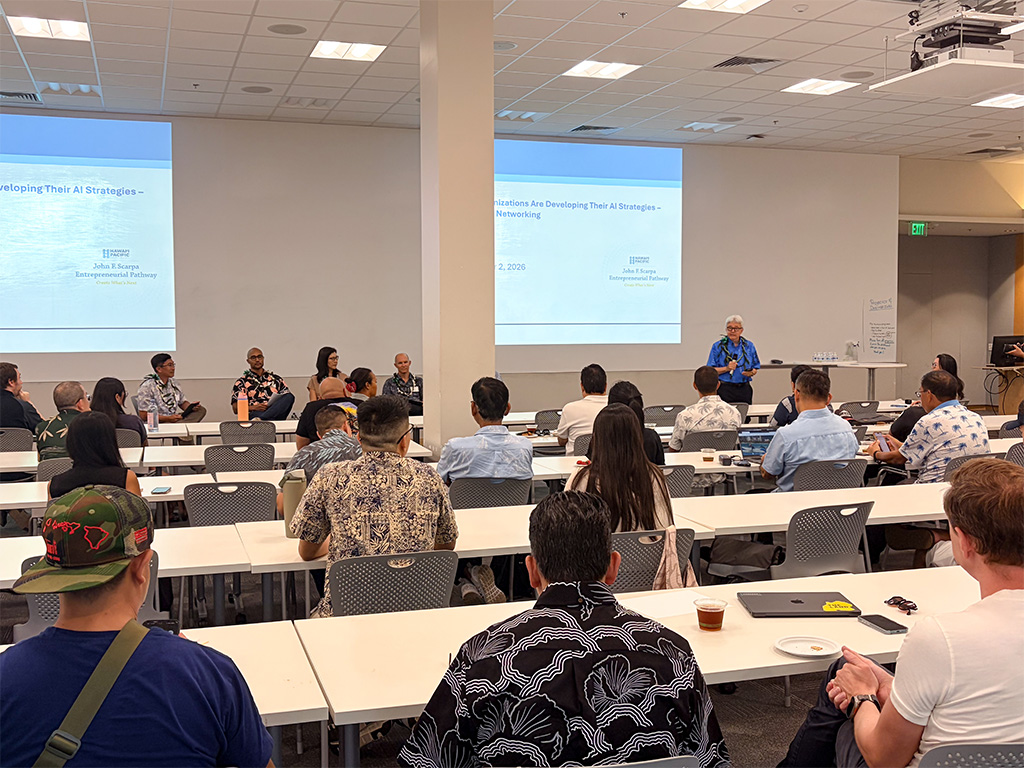
HPU President John Gotanda opens the Hawaii Tech Week AI Strategy Panel with remarks on the University's mission and values.
The panel discussed how organizations across Hawaiʻi are adopting AI to improve operations, drive innovation, and prepare their workforces for what comes next. HPU Trustee and alumnus Iven Sugai moderated. Born and raised on Oahu, Sugai served 28 years in the Army, including assignments at the White House and with Congress, and retired as a lieutenant colonel. He carried that operational discipline into the technology sector, most recently as chief of staff and global portfolio manager at Meta.
Panelists included:
HPU Senior Vice President and General Counsel Kenji Price, a Mililani High School graduate, was Senate-confirmed in 2018 as United States attorney for the District of Hawaiʻi, serving as the state's chief federal law enforcement officer and leading an office of more than 20 attorneys. He later became a partner at McDermott Will & Emery in Washington, D.C., and served as managing counsel at Epic Games, developer of Fortnite.
Jason D'Olier, executive vice president of artificial intelligence at Bank of Hawaiʻi, has spent 14 years at the bank, most of that time in finance and risk. He began his career teaching high school mathematics at Mid-Pacific Institute before earning an MBA at Georgetown University and working at Citigroup.
Jason Higa is chief executive officer of FCH Enterprises, the parent company of Zippy's, which is celebrating its 60th year. Higa represents the second generation of the family business and practiced law for five years before joining the company in 1995.
Rebecca Cai has served as chief data officer for the State of Hawaiʻi for about two years, where she leads AI strategy, policy and implementation across state departments. She previously served as chief data officer for New York State and worked in technology and strategy consulting at McKinsey, Deloitte and IBM.
HPU President John Gotanda opened the discussion by placing the conversation within the University's mission and values.
"Artificial intelligence is rapidly transforming everything from how we work, how we learn, how we live," he said, framing the discussion as one "not simply about what AI can do, but how we can use it thoughtfully and how we can use it responsibly.
"At HPU, our mission is to prepare our students to succeed in the changing world. We want our graduates to succeed both professionally and personally, and to also think critically, to act ethically, and to contribute to their communities. Our work is grounded in our values of aloha, pono, and kuleana. As technology advances, it reminds all of us that innovation in the end should ultimately serve people and serve their communities. We are honored that you are able to join us today, and we are grateful for all of you being a part of this conversation."
HPU Dean of the College of Business Amy Nguyen-Chyung, Ph.D., is a member of the University's AI Task Force. She welcomed the audience and leads the John F. Scarpa Entrepreneurial Pathway, which she says works with students, alumni, and faculty "to create an entrepreneurial culture that empowers our students to be leaders and creatively solve problems and find meaningful solutions for the future." This summer the pathway ran a boot camp for roughly 60 high school students from 20 schools across Hawaiʻi.
Sugai opened the discussion by setting aside the tools. A strategy, he told the audience, comes down to three things: the outcomes an organization wants, the approaches it will take, and the resources required to get there.
Price described how HPU built its own strategy, beginning with a recognition that the University already had AI activity underway in scattered corners.
"We recognized that there were a lot of pockets of activity at the University that involved the use of AI," Price said. "But we also recognized the value of actually having a coordinated approach to that."
Price and HPU Dean of the College of Professional Studies Mani Sehgal, Ph.D., co-chair the AI Task Force, which is more than 20 HPU faculty and staff drawn from every college and from the administrative side of the house and met monthly for roughly seven months, organizing its work around outcomes, approaches and resources, what Price called ends, ways, means. The task force is charged with developing a comprehensive AI strategy for the University and coordinating University-wide AI adoption efforts to promote student success and enhance operational efficiency. The size of the group was deliberate, Price said, and reflected the university's commitment to shared governance.
"Some people may say too many cooks in the kitchen is a bad thing," he said. "Well, it depends on how much you like to eat."
Asked how HPU will measure whether the strategy worked, Price noted that he was the only panelist representing a nonprofit. On the administrative side, the University can speak the same language as everyone else on the stage: efficiency, return on investment, time returned to work that requires human judgment. The academic side resists that kind of accounting.
"At the end of the day, we exist to promote student success," Price said. "And that's what we do at HPU."
The measures HPU can track include faculty training, student learning objectives and retention, which Price framed less as a statistic than as an obligation. "How can we use AI to keep them here, equip them with the tools to persist and support them the best way that we can?"
The larger goal, he acknowledged, will take years to assess. "We've got to play the long game."
Summing up the range of perspectives on the panel, Sugai returned to where he'd started. "For any good strategy to work, it does take people," he said. "You can't just build an agent by itself and let it run off and do things."
D'Olier, Cai and Higa each traced a different route to a similar conclusion, describing coalitions, scoring frameworks and employee training programs that put strategy in the hands of the people closest to the work.
The following afternoon at Aloha Tower Marketplace, HPU hosted a second Hawaii Tech Week event, Build with AI: Student Hackathon, a three-hour, no-coding-required session that walked students through using AI tools to take an idea from a research question to a working prototype and pitch.
HPU extends a special mahalo to Sugai for his moderation, to the panelists for their time and candor, and to Hawaii Tech Week for bringing the conversation to HPU.