

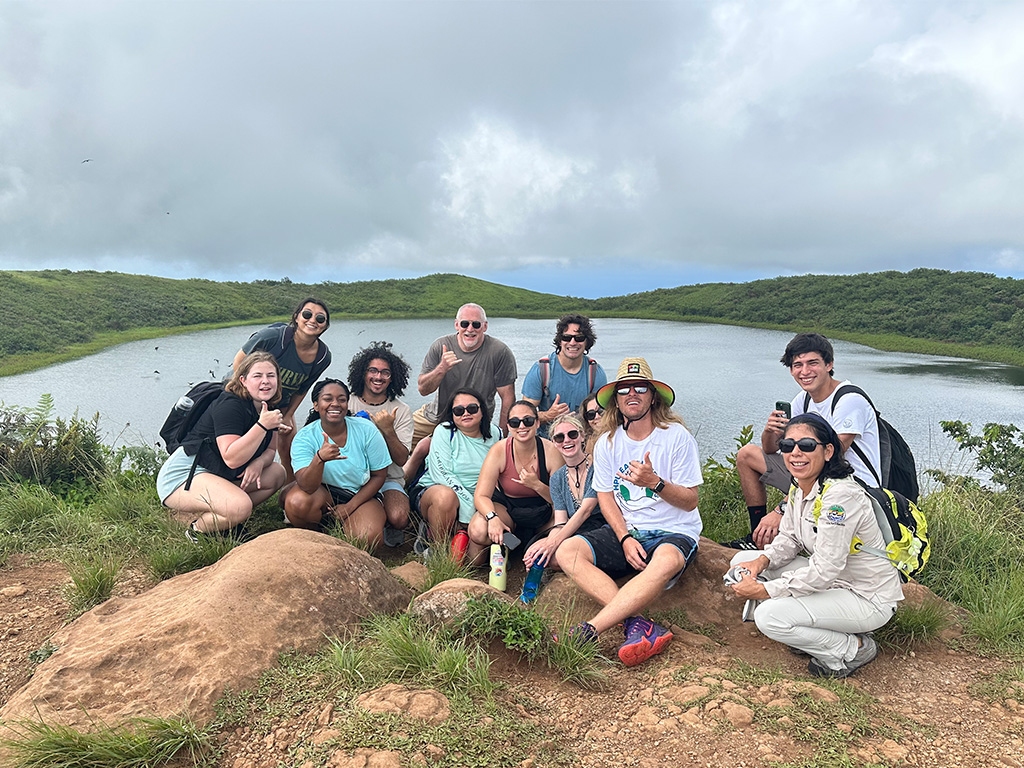
HPU students take in El Junco Lagoon, the only permanent freshwater lake in the Galapagos and a spot where frigatebirds come to rinse salt from their feathers. The study abroad trip, organized by HPU Associate Professor Adam Burke (center, in the straw hat), gives MASUST students the chance to analyze sustainable features in another tourism-dependent archipelago in the Pacific.
The HPU Master of Arts in Sustainability (MASUST) program, the first and only graduate program of its kind in Hawaiʻi, has some big news. In July 2026, the program received initial accreditation from the Sustainability Education Accreditation Commission (SEAC), making it the first sustainability program in the country to earn the five-year award. The accreditation took effect Aug. 1, 2026, and runs through July 31, 2031.
The SEAC accreditation of HPU's MASUST program is the first sustainability program in the country to earn the five-year award.
In its decision letter, the Commission commended HPU faculty for what it called an "exceptional commitment to advancing professional sustainability competencies." Accreditors singled out the program's balance of conceptual and applied skills, its use of real-world experience, the depth of its personal advising and support, the sense of community among students, faculty and the wider community, and field-based learning that contributes to the wellbeing of Hawaiʻi's land and people.
"As one of the earliest sustainability programs in the U.S., our faculty and students are so excited to be the first sustainability program to achieve SEAC accreditation," said HPU Associate Professor and MASUST Program Director Serge Marek, Ph.D. "The accreditation process, while challenging, was a wonderfully collaborative experience that helped our program recognize and emphasize continuing excellence, as well as key areas of future growth. HPU's MASUST program produces highly competent sustainability professionals, and acquiring SEAC accreditation, within a national network of accredited programs, will help us continue to achieve this goal."
Launched in 2007, the MASUST program is known for its small class sizes that allow for close collaboration between faculty and students, hands-on approach to learning, and the field work that takes students and faculty members directly into the community where students make a difference right away.
The program's field work has reached well beyond the Hawaiian Islands. Graduate students have traveled to the Galapagos for three weeks of study on San Cristobal and Santa Cruz, earning credit while examining sustainable development, conservation, and ecosystem management in a place that, like Hawaiʻi, carries the weight of its own tourism economy. The course has been led by HPU Associate Professor Adam Burke, Ph.D., who has been conducting research in the archipelago since 2012.
Most students enroll in MASUST while they are already working, and the degree is built around that. Classes meet on campus in the evening, students start in either fall or spring, and a full-time schedule carries them through 36 credits in 21 months.
Coursework runs from sustainable tourism and sustainable cities to ecological economics, systems thinking, and global climate change. At the center of it all is the professional paper, an original piece of research each student designs and carries out in a local community, on a problem they picked themselves. The degree is also STEM OPT eligible, which matters to international students planning to stay and work after graduation allowing three years of work as opposed to the usual one year.
Getting to that paper means being out in the field early and often. Every semester brings service learning with partner organizations around the islands. At Sumida Farm in Aiea, a well-known, family business watercress operation, students learn what urban agriculture is worth in a place where the stakes are visible from an adjacent parking lot and mall. Internships put students alongside working professionals before they graduate, and electives let them borrow from marine science, business, and other graduate programs when their questions run that way. That balance of classroom and field is what SEAC reviewers kept returning to.
"Our voluntary, holistic, peer-driven accreditation framework is a powerful lever for improving the quality, visibility, and impact of sustainability degrees in higher education," said SEAC President Krista Hiser, Ph.D. "The Commission recognized the HPU program's excellence in creating balance between conceptual and applied skills, and its emphasis on incorporating real-world learning experiences."
MASUST graduates go on to work in state and federal government, energy and utilities, environmental services, planning and policy, cultural institutions, and climate science. Sierra Vaughn (’19) is a forest utilization coordinator for the Hawaiʻi Wood Utilization Team, and Lauren Reichelt (’17) is a project lead at the National Renewable Energy Laboratory. Danielle Lien (’13) is director of Green Climate Fund Relations and Implementation Oversight at the World Wildlife Fund, and Josh Prigge (’11) is founder and senior consultant at SUSTRIDGE. Other graduates have gone on to work at FEMA, the Los Angeles Cleantech Incubator, the Sierra Club, Pacific Northwest National Laboratory, and the Norwegian National Rail Administration.
Students who want to start smaller can also earn a graduate certificate in one of three areas: Global Leadership and Sustainable Development; Environment, Policy, and Leadership; and Sustainability and Security Studies (co-listed with MA Global Diplomacy & Security program).
For many graduates, the connections they make along the way turn out to be just as valuable as the degree itself.
"Connections made through school or volunteering opportunities are invaluable," said MASUST alumnus Cyrus Howe. "Once you're outside doing actual sustainability work, you're able to meet new people and talk with others who share your values and are passionate about sustainability."
To learn more about HPU's Master of Arts in Sustainability, click here.