

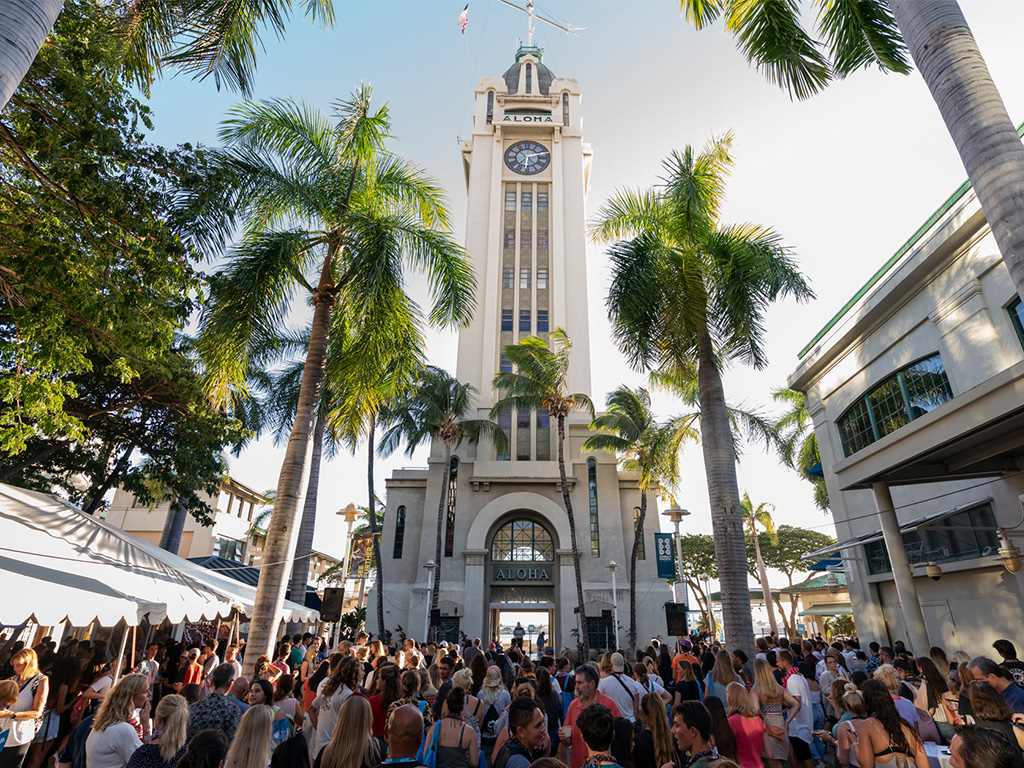
Aloha Tower was built in 1926 and today remains woven into the daily life of students at HPU.
On July 24, AIA Honolulu held its 68th annual Design Awards gala at the Hawaiʻi Theatre. The event featured awards honoring excellence in architectural design, with more than 200 people attending and over 1,000 votes cast by the public over a two-week period in June for the 20th annual People's Choice Award. According to an article by Aloha State Daily, the evening's other awards were determined by a panel of jurors composed of AIA member-architects, including three local jurors and architects based out of Kansas City and Canada.
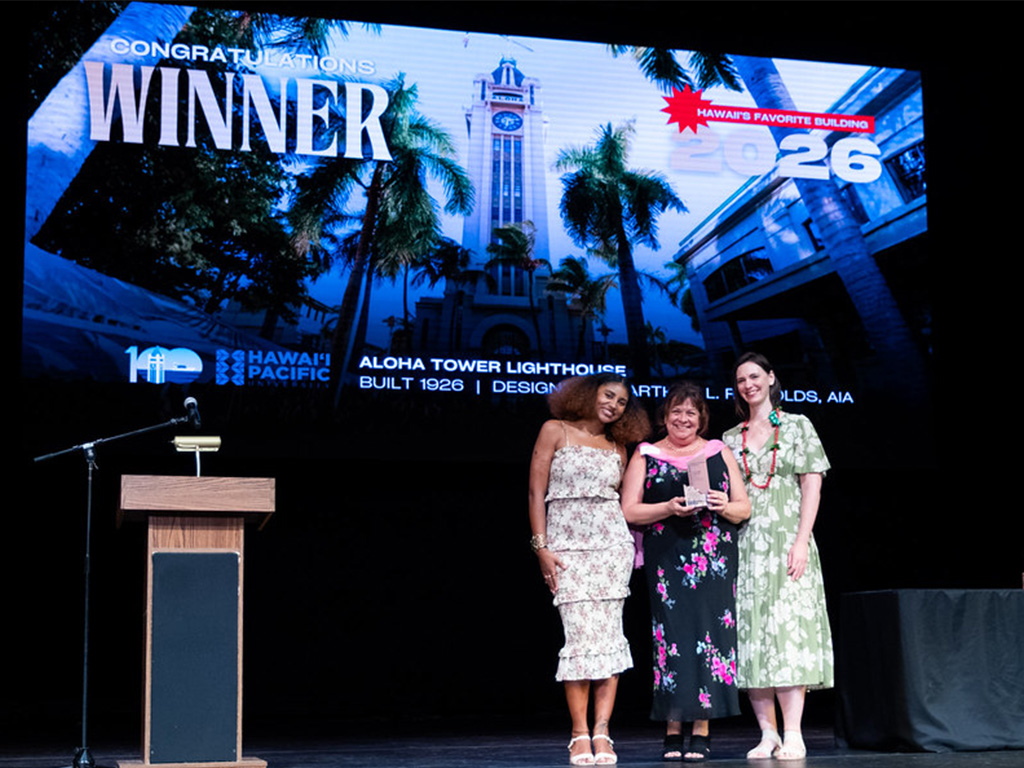
HPU's Maureen Silva (center) and Olivia Ngokion (left) accept the AIA Honolulu People's Choice Award on the University's behalf, with Katrina Valcourt, executive editor at HONOLULU Magazine (right). Image courtesy of Anthony Consillio.
Aloha Tower was up against iconic buildings like ʻIolani Palace, First Hawaiian Bank Tower, the Hawaiʻi State Capitol, and the Honolulu Academy of Arts. It took home the People's Choice Award in its centennial year, the same year it is undergoing renovation. The HPU campus community could not be more excited to honor the tower that has watched over Honolulu Harbor for the past 100 years.
The tower is a retired lighthouse and one of the most recognized landmarks in the state of Hawaiʻi. Built in the Hawaiian Gothic style, it is home to a seven-ton, weight-driven clock that was one of the largest in the United States at the time of its construction. Its opening, on September 11, 1926, came at a cost of about $160,000, a considerable sum for the era.
Current historical preservation work will mimic the tower's original 1926 color palette and architectural integrity, and the plan is to reopen the observation deck to visitors this year. Designed by San Francisco architect Arthur L. Reynolds, the tower was placed on the National Register of Historic Places in 1976.
Standing at 184 feet tall, Aloha Tower was at one time the tallest building in Hawaiʻi, a distinction it held for four decades, according to HPU Professor of History Douglas Askman, Ph.D. It was constructed to house various government offices, including the Harbor Master's office. On the 10th floor, an observation deck doubled as a lookout for harbor pilots. At the top of the deck, the word "ALOHA" was etched into all four sides of the structure to greet arriving visitors. In the decades before mass air travel, the tower stood as the first welcome ship passengers received upon arriving on Oʻahu.
That role as a greeter of newcomers gave rise to "Boat Days," a tradition in which crowds gathered at the harbor to welcome arriving ships with lei, music from the Royal Hawaiian Band and hula performances. The custom continued until jet travel largely replaced ocean liners in the 1950s.
The tower's history took a sharper turn after the attack on Pearl Harbor. Following the Japanese attack on Pearl Harbor in December 1941, Aloha Tower was placed under the control of the United States Navy, Askman notes. Public access was restricted, and the building was placed under constant military guard. The once-white tower was painted camouflage, and a high level of security was implemented, as Aloha Tower had become a control center for American military convoys in the Pacific. Even after the war ended, the tower remained under military jurisdiction. It was not returned to civilian control until 1947, when the camouflage paint was finally removed.
Today, Aloha Tower remains woven into daily life at HPU. The University’s Aloha Tower Marketplace houses HPU student housing at its Harbor Lofts, classrooms, dining rooms, its HPU eSports Arena, Sharkey’s Cove, and Pier 9 by Sam Choy, which provides healthy, tasty meals to students living on campus. For a tower that spent a century welcoming newcomers to Hawaiʻi by sea, it continues that legacy by welcoming students, families, and friends to campus on the Honolulu Harbor, a serene university setting like none other in the country.